It’s not a tech trend. It’s a monetary revolution.
Bitcoin Stands Alone
To lump Bitcoin in with “crypto” is to fundamentally misunderstand both. Bitcoin is not one project among many—it is the discovery of absolute digital scarcity. Everything else is just trying to sell you a version of that discovery, with tradeoffs that defeat the point.
Crypto is full of feature-rich platforms, flashy marketing, and financial speculation. Bitcoin is minimalist, principled, and unstoppable. One exists to extract liquidity. The other exists to preserve time, truth, and energy.
Most of Crypto Is Noise—Bitcoin Is Signal
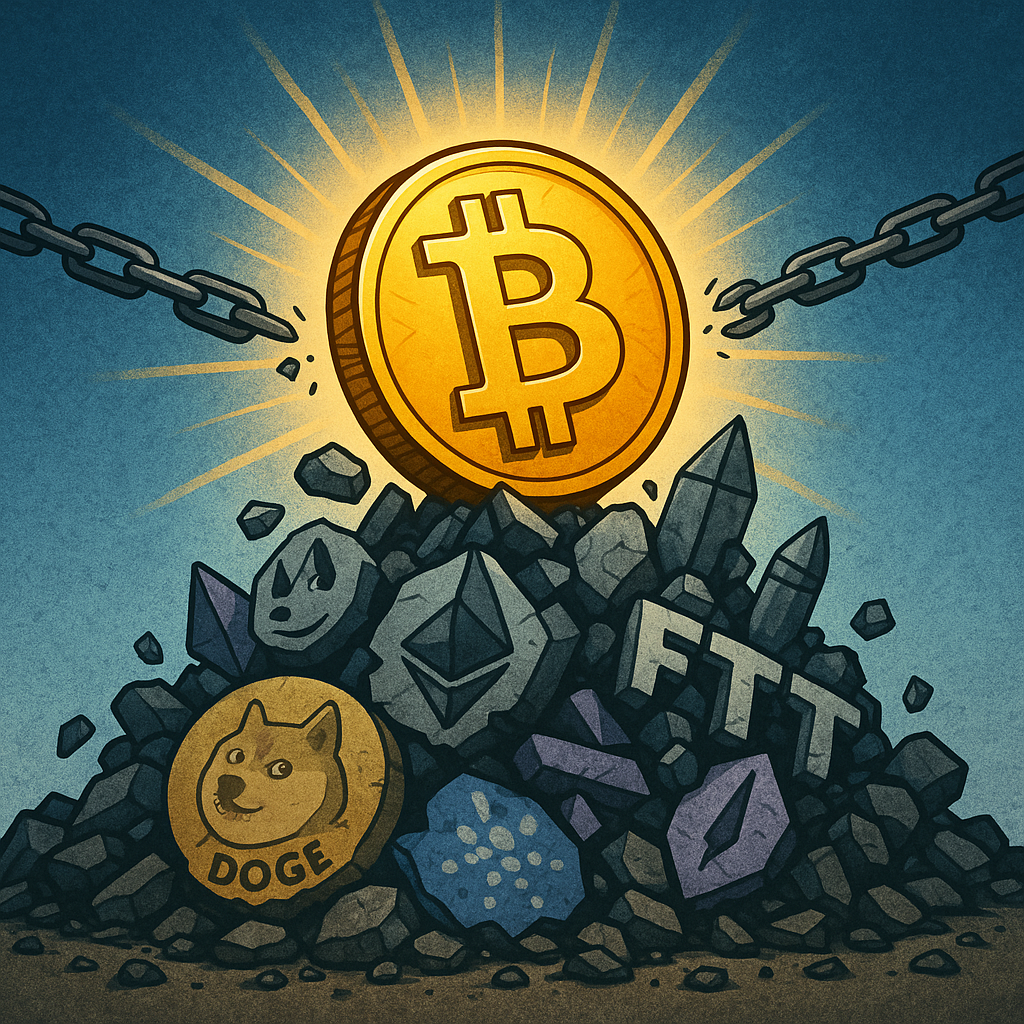
There are more than 20,000 tokens listed across various exchanges. The vast majority have no meaningful user base, are maintained by centralized teams, and are subject to premines, rug-pulls, regulatory capture, or simply market irrelevance. Projects like Terra/LUNA, FTX’s FTT token, and countless meme coins have imploded, leaving retail investors holding the bag. Others are in the process of fading into irrelevancy.
Bitcoin, conversely, had an immaculate conception. There was no venture capital, no pre-mine, no foundation, and no founder enrichment. Satoshi Nakamoto mined the early blocks openly, announced the project on public forums, and disappeared—leaving the network leaderless and immune to capture. The rules became fixed. Consensus emerged organically through open-source collaboration and voluntary adoption—not marketing.
Bitcoin Doesn’t Need to Be Feature-Rich
Bitcoin doesn’t aim to do everything. It aims to do one thing well: be incorruptible money. Like TCP/IP for the internet, Bitcoin is a base layer—a protocol on which others can build, not a product chasing features.
It doesn’t need built-in NFTs, DeFi, or identity frameworks. What it has—and what no other chain has sustained—is true decentralization, unrivaled security, and total immutability. No one controls it, no one can change its rules arbitrarily, and no single point of failure can take it down.
Its deliberate conservatism is a feature, not a bug. In money, reliability beats novelty every time.
Scalability Is Achieved Through Layers
Altcoins often promise infinite throughput and low fees—but only by sacrificing decentralisation or security. Bitcoin takes a layered approach: the base layer is optimised for settlement, security, and finality; secondary layers like the Lightning Network handle speed, scale, and microtransactions.
This is how real-world systems scale—by modular design, not by stuffing every function into the base layer. The internet grew by layering protocols (HTTP, SMTP, SSL) on top of TCP/IP. Money will follow the same path.
Proof-of-Work > Proof-of-Marketing
Bitcoin’s security model is backed by proof-of-work, meaning miners expend real-world energy to secure the network. This makes Bitcoin censorship-resistant and incredibly hard to attack. Its hashrate (currently over 800 exahashes per second) dwarfs any other network, reflecting its unmatched security.
Crypto, on the other hand, often runs on proof-of-stake systems controlled by insiders and influenced by governance token holders. These systems are more centralised and prone to political capture, and resemble the fiat system more than they emulate bitcoin.
Moreover, crypto lives on hype: celebrity endorsements, paid influencers, social media campaigns. It sells future promises, not present resilience. Bitcoin just runs—24/7, for 15 years, without a single moment of downtime.
Money Converges to One—And That One Is Bitcoin
History shows that money is subject to network effects. Societies don’t juggle dozens of currencies forever—they converge on the most liquid, secure, and widely accepted form. Bitcoin already leads on every front: market cap (~$2 trillion), user base, daily settlement volume, and infrastructure support.
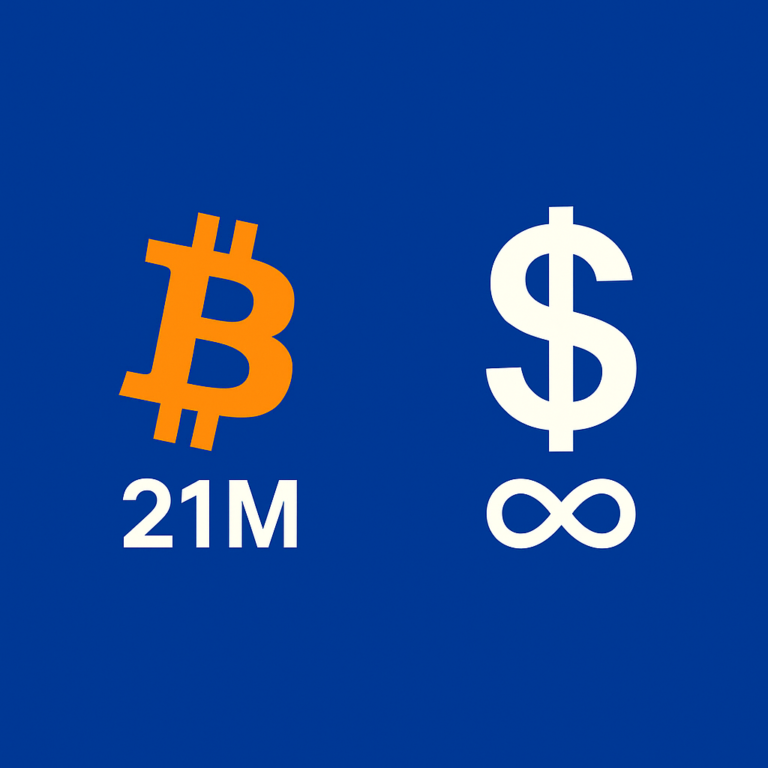
Most importantly, Bitcoin’s monetary properties are not just superior—they’re singular. Its absolute scarcity (21 million coins) is enforced by consensus and protected by energy-backed proof-of-work. That scarcity cannot be repeated or re-discovered. Any attempt to “copy” Bitcoin immediately lacks the neutrality, credibility, and game-theoretic foundations of the original.
Scarcity is a binary discovery. It only happens once. Everything else is an imitation.
The Bottom Line
- Crypto is noise. Bitcoin is signal.
- Crypto sells hollow ‘innovation’. Bitcoin offers monetary salvation.
- Bitcoin isn’t part of the crypto industry. It’s the escape hatch from all of it—and the only honest money ever born on the internet.