
Introduction
Civilisation emerges through voluntary cooperation, division of labour and exchange, enabled by sound money that supports saving, capital formation and rising productivity. Yet history repeatedly shows sound money becoming centralised, captured and debased, progressively corrupting the incentives upon which civilisation depends. Bitcoin offers something historically unique: a money resistant to capture and impossible to debase. What might this mean for individuals, markets, communities, political order and civilisation itself?
Bitcoin’s finite supply and resistance to monetary debasement make it a potential long-term store of value. Combined with its monetary properties and growing network effects, this creates an incentive to save rather than immediately consume, preserving future optionality and expanding an individual’s economic time horizon. Greater savings support capital formation, increasing productivity, abundance and living standards. Growing prosperity enables longer-term planning, stronger families and greater intergenerational thinking, which strengthen the communities upon which civilisation depends. By rewarding saving, bitcoin therefore incentivises present sacrifice for future prosperity rather than sacrificing the future for present consumption.

In a fiat economy, proximity to the money printer is rewarded through the ‘Cantillon effect’; where the earlier one receives the newly created currency, the more they can benefit from its debasement. This incentivises cronyism, regulatory capture, and rent-seeking, while enabling subsidised leverage, bailouts and price distortions in markets. None of this promotes a healthy or sustainable civilisation. Conversely, bitcoin removes money printing altogether, shifting economic incentives back toward competitive value creation. When monetary privilege is no longer available, wealth must instead be earned through voluntary exchange. As free market competition ensues, profits reward those who add value to scarce resources, while losses expose capital misallocation and allow resources to migrate elsewhere. Bitcoin therefore strengthens free-market meritocracy by shifting incentives toward value creation, improving resource allocation, and enabling greater abundance through productivity.

Currency debasement penalises cash savers by eroding their purchasing power, and drives individuals to purchase scarce assets such as property and equities to preserve wealth. This store-of-value demand adds a ‘monetary premium’ beyond an asset’s underlying utility or productive value. In housing, this can inflate prices far beyond their value as shelter, reducing affordability and attracting further speculation. In financial markets, monetary premiums can similarly inflate valuations and direct capital toward more leveraged or speculative investments rather than genuinely productive enterprises. Such misallocation reduces economic efficiency by diverting scarce capital from more productive uses. Bitcoin offers an alternative by restoring the store-of-value function to money itself. If wealth can be reliably preserved in money, individuals have less need to monetise houses, equities and other scarce assets. This would reduce monetary premiums and allow prices to more accurately reflect an asset’s underlying utility. When housing affordability, capital allocation and economic output are improved, the foundations of civilisation are strengthened.

Fiat monetary expansion is often achieved by suppressing interest rates below what the free market would otherwise support. This artificially incentivises borrowing, leverage and speculation while driving up consumer prices and asset valuations. Rising asset prices can then justify further borrowing, creating a self-reinforcing cycle of leverage and malinvestment that leaves the economy vulnerable when credit conditions are tightened. As discussed in ‘Austrian Economics’, the manipulation of interest rates is a fundamental contributor to the boom-bust cycle that characterises fiat economies. When interest rates are eventually raised, the resulting deleveraging can trigger liquidations, capital destruction, unemployment and recession. Unlike fiat currencies, bitcoin cannot be printed to artificially expand the monetary base or suppress market interest rates. In a bitcoin-based economy, lending would therefore face meaningful constraints and interest rates would be determined by natural price discovery. Scarce credit would raise borrowing costs and discourage marginal investments, while abundant savings would lower them. This self-regulating effect would naturally reduce leverage and malinvestment, leading to greater financial stability, improved economic security and a more resilient civilisation.

Monetary debasement relaxes the fiscal constraints on government, enabling political power to expand, centralise, and foster corruption that increasingly rewards those in proximity to the state. Bitcoin removes that funding mechanism altogether, forcing governments to rely more on explicit taxation and genuine borrowing. This limits state expansion and encourages smaller, more decentralised governance, where decision-makers are closer to the communities they serve and therefore more accountable. Bitcoin’s global portability would also incentivise governments to attract rather than merely extract from productive citizens. As political power decentralises, greater responsibility can also return to individuals, families, churches, neighbourhoods and voluntary organisations, allowing civil society to reclaim functions previously absorbed by the state. By fixing the money, bitcoin could therefore decentralise power itself, shifting responsibility away from decaying and bloated institutions toward individuals and their communities.
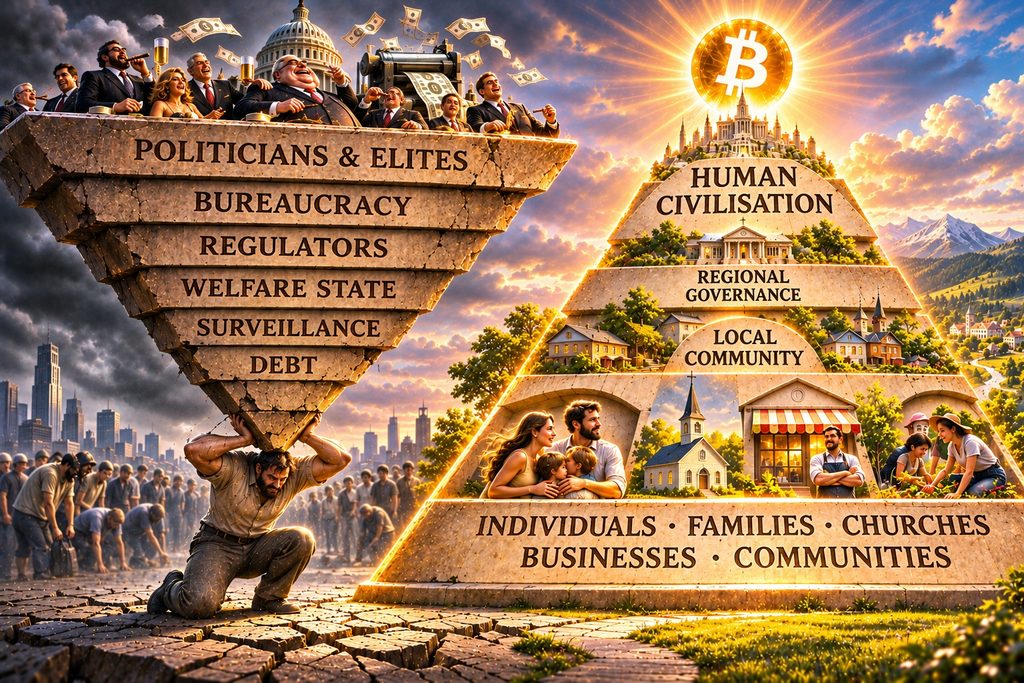
Today, the global economy is fragmented across national currencies, creating monetary frictions that make trade and capital flows dependent upon intermediaries, foreign exchange infrastructure and political permission. These barriers impede international exchange and create opportunities for political corruption and rent-seeking. In this sense, nation states can resemble legalised cartels, where the global economy is partitioned into protected jurisdictions where political access confers economic advantage. Bitcoin offers an alternative: an open, permissionless and globally interoperable monetary network requiring no central political authority. As global money, bitcoin could reduce monetary barriers to cross-border trade and investment, allowing capital to flow more readily toward productive opportunities and enabling businesses to access deeper international markets. Better global capital allocation and market participation would increase productivity while deepening the international division of labour. Greater economic interdependence also raises the opportunity cost of conflict by making peaceful cooperation increasingly valuable. Bitcoin could therefore promote global productivity, cooperation and peace by providing a neutral monetary foundation for voluntary exchange across political borders.

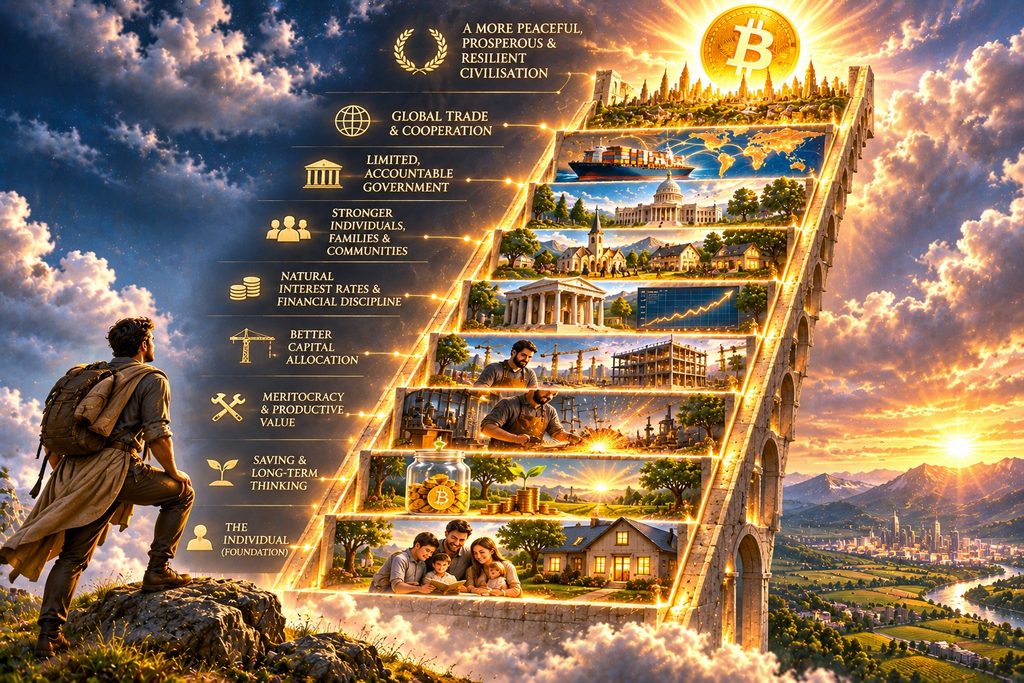
Individuals are the fundamental units of civilisation, and their collective actions are shaped by the incentives they face. Because money coordinates all economic activity, its incentives profoundly influence the trajectory of civilisation. Unlike fiat currency, bitcoin rewards saving, long-term thinking, and meritocratic value over proximity to the state. It also reduces forced speculation, monetary premiums and misallocaiton of capital. Naturally-discovered interest rates further constrain leverage and malinvestment, while firmer fiscal limits encourage smaller, more accountable and competitive governments. As political power decentralises, responsibilities previously absorbed by the state can return to individuals, families and communities, making society more resilient. Meanwhile permissionless global trade deepens the division of labour and incentivises peaceful interdependence over violence. Bitcoin doesn’t change human nature, but it does change the economic selection pressures under which people operate. By making productive, responsible and cooperative behaviour relatively more rewarding, bitcoin provides an ethical monetary foundation upon which a more peaceful, prosperous and resilient civilisation could emerge.
Completed: Why Bitcoin?
Continue your learning by exploring the ‘How Bitcoin Works’ section below.
Next Steps: How Bitcoin Works
Learn what Bitcoin is engineered to do, how it does it, and how it may emerge as the next global money: