
Introduction
For most people today, money and government appear inseparable. Yet money does not inherently require a state, central bank or issuing authority. Instead, sound money emerges voluntarily through trade, just as gold did long before fiat currencies existed. Throughout history, however, governments have progressively centralised control over money in order to expand its supply and harness human labour. Bitcoin fundamentally breaks this relationship by replacing the monetary issuer with decentralised consensus and predetermined rules. It allows money to exist independent of political authority, potentially separating money from state for the first time.
Throughout history, states seeking monetary control have often followed a similar progression. First, they borrow credibility from existing sound money, either by minting coins from precious metals or issuing notes redeemable for them. In doing so, they offer people convenience in exchange for trust in the issuer. Once issued, governments typically reinforce demand by requiring taxes and other obligations to be settled in their currency, while disadvantaging competing monies through regulation. After sufficient compliance has been achieved, any original monetary constraints can be relaxed through dilutive alloying of coins, suspension of convertibility or unbacked money printing. For as long as public trust is preserved, the state can steal human labour in perpetuity through the debasement of its currency.

People exchange their finite time and productive effort for money so that its value can be carried into the future. Money therefore represents stored human labour. Controlling its supply gives the state a mechanism for indirectly appropriating the fruits of that labour. By creating new currency, the state and its beneficiaries can acquire real goods and services by transferring purchasing power from existing holders to themselves. Unlike overt confiscation or slavery, this extraction is less conspicuous, appearing instead as rising consumer prices. In this sense, monetary debasement enables the state to steal a portion of human productivity without overtly commanding the labour that produced it, making the transfer less visible and the theft more deniable.

Currency debasement enables governments to command resources far beyond what they can explicitly raise through taxation. This alleviates the need for fiscal discipline, allowing the state to expand beyond what citizens might willingly finance. As control of and proximity to government become increasingly lucrative, incentives for rent-seeking, cronyism and corruption grow, while the expanding public sector parasitises the productive economy. Monetary debasement therefore distorts economic and political incentives, rewarding those who capture state power with unearned access to society’s resources.
As government expands, it consumes more resources, requiring a combination of higher taxation, additional borrowing and further debasement. As more purchasing power is siphoned off by the state, the currency depreciates, causing inflation and discontent. Governments often respond with subsidies, handouts and price controls, but these interventions only introduce new distortions. Price ceilings, for example, create supply shortages and black markets, while subsidies and handouts incur additional fiscal costs. Inevitably, falling confidence in the currency and its institutions can contribute to social unrest, political upheaval and regime collapse. History provides striking examples of this progression, including ancient Rome, Song China, Revolutionary France and Weimar Germany.

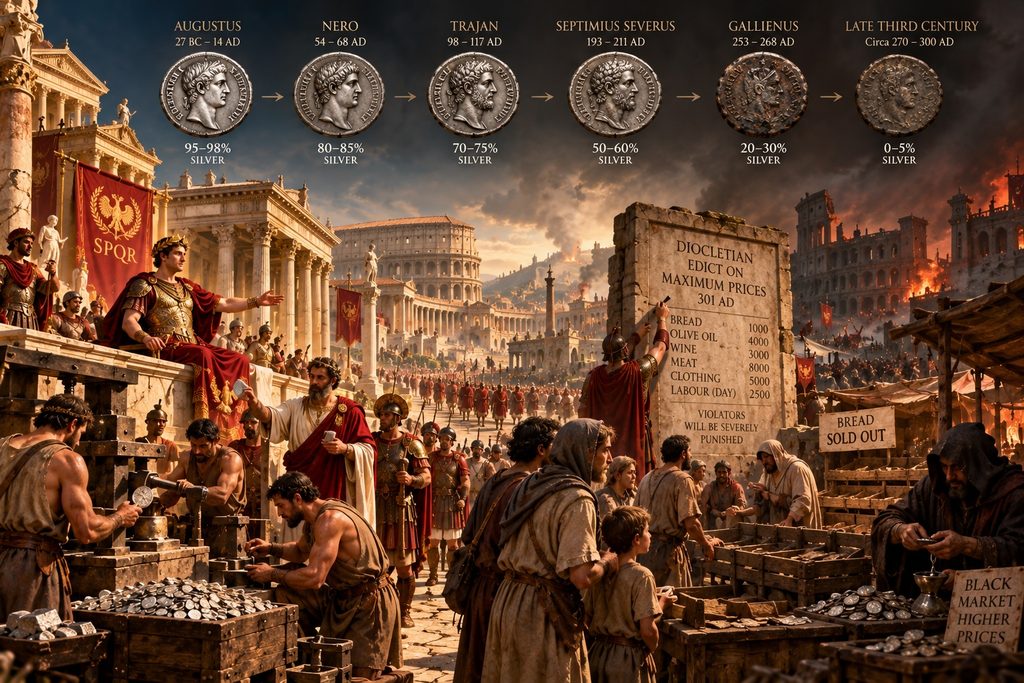
An early example is the progressive debasement of Roman silver coinage. Under Augustus, the denarius contained roughly 95-98% silver, but Nero began diluting its purity around 64 AD, a practice continued by later emperors. As military and political ambitions grew, successive debasement allowed the state to extract greater spending power from its precious-metal reserves, until the late third century when coins contained only traces of silver. This debasement contributed to the Crisis of the Third Century (235-284 AD), a period of severe inflation, civil war and political instability. Emperor Diocletian later attempted to suppress rising prices through his Edict on Maximum Prices in 301 AD, only to exacerbate shortages and fuel black markets. Rome therefore illustrates a recurring pattern: political ambitions incentivise monetary debasement, leading to inflation and economic instability, and inviting counterproductive interventionist policies.
The invention of paper money in Song China removed much of the physical constraint that metallic coinage placed on monetary debasement. Around 1023 AD, the Northern Song established the jiaozi, a state-issued paper currency initially subject to issuance limits and supported by coin reserves. However, as fiscal and military demands grew, these constraints were repeatedly exceeded, leading to inflation. After the Jurchen conquest ended the Northern Song in 1127, the Southern Song introduced the huizi, whose issuance constraints were likewise progressively relaxed, resulting in severe inflation. Following the Mongol conquest in 1279, Kublai Khan’s Yuan Dynasty imposed yet another currency, its paper chao, while restricting the monetary use of precious metals. Again, the chao suffered inflation due to unbacked issuance. China thus demonstrates that once currency can be decoupled from sound money, the political incentives repeatedly favour debasement at the expense of economic stability.

An acute example occurred during the French Revolution. Following the Crown’s debt crisis in 1789, the revolutionary government confiscated Church lands and issued paper assignats against them. Initially interest-bearing and land-backed, the assignats were later transformed into legal tender and increasingly printed to finance government expenditure. As inflation accelerated, authorities imposed severe penalties for refusing or discounting them, while also enforcing price controls through the Law of the Maximum in 1793. This ultimately failed, contributing to shortages and black markets, and debasement continued until the assignat hyperinflated into worthlessness. Its replacement, the mandat territorial, was likewise debased and rapidly suffered a similar fate. The resulting monetary collapses devastated savings and creditors before stability was eventually restored through a bimetallic (gold/silver) standard under Napoleon in 1803. Revolutionary France therefore demonstrates how monetary debasement can lead to inflation, coercive enforcement, maladaptive intervention and ultimately currency collapse.

Perhaps the most infamous modern example occurred in Germany between 1914 and 1923. At the outbreak of World War I, the German Empire suspended gold convertibility of the mark and financed much of the war through debt and money printing. Defeat left the Weimar Republic with massive war debts, fiscal deficits and onerous reparations, which the government attempted to resolve by further debasing its currency. In 1923, the resulting hyperinflation led to an exchange rate of 4.2 trillion marks per US dollar, devastating German peoples’ savings and fixed incomes. A monetary reset was attempted via the asset-backed Rentenmark, but the loss of institutional trust lead Germany to rely on Wall Street credit, ultimately exposing it to the American lending collapse of 1929. The resulting Depression, combined with the legacy of war, inflation and political instability, helped create conditions in which political extremism flourished. Weimar therefore demonstrates how monetary debasement can destroy a currency, devastate accumulated savings and contribute to political instability.

Human history demonstrates a recurring vulnerability: once states control money, they acquire both the ability and incentive to debase it. The United States represents the modern culmination of this pattern. Its first paper currency, the Continental, was issued in 1775 and its acceptance was compelled in some states with severe penalties. However, its over-issuance ultimately caused it to collapse, leading to social unrest and the phrase “not worth a continental”.
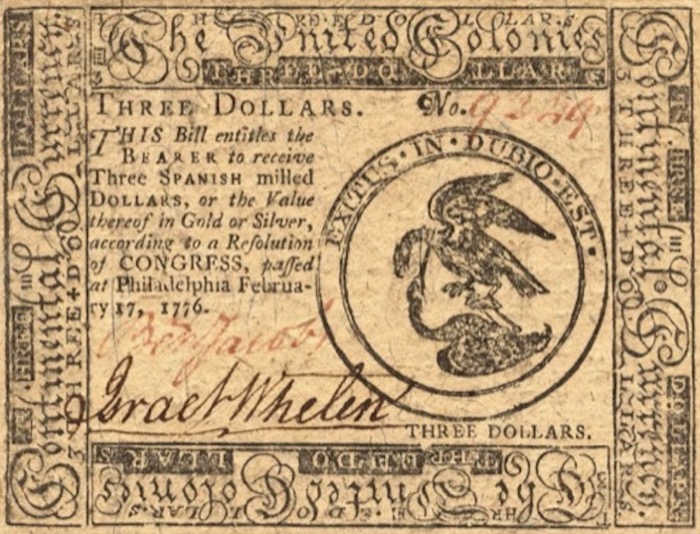
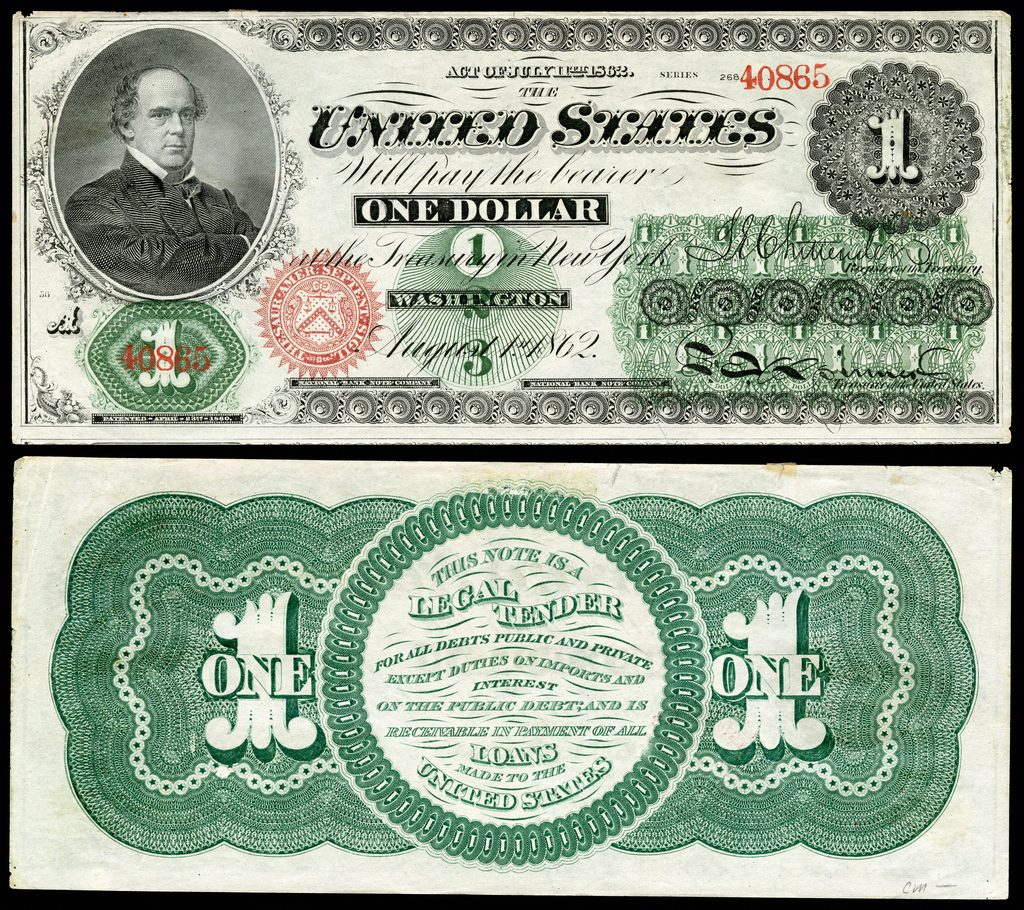
The Constitution subsequently prohibited states from making anything but gold and silver coin legal tender, but imposed no such restriction on the federal government. During the Civil War, the federal government issued more than $450 million in paper greenbacks and made them legal tender through the Legal Tender Acts. The Federal Reserve Act of 1913 then further centralised monetary power and established a federally managed “elastic currency.”
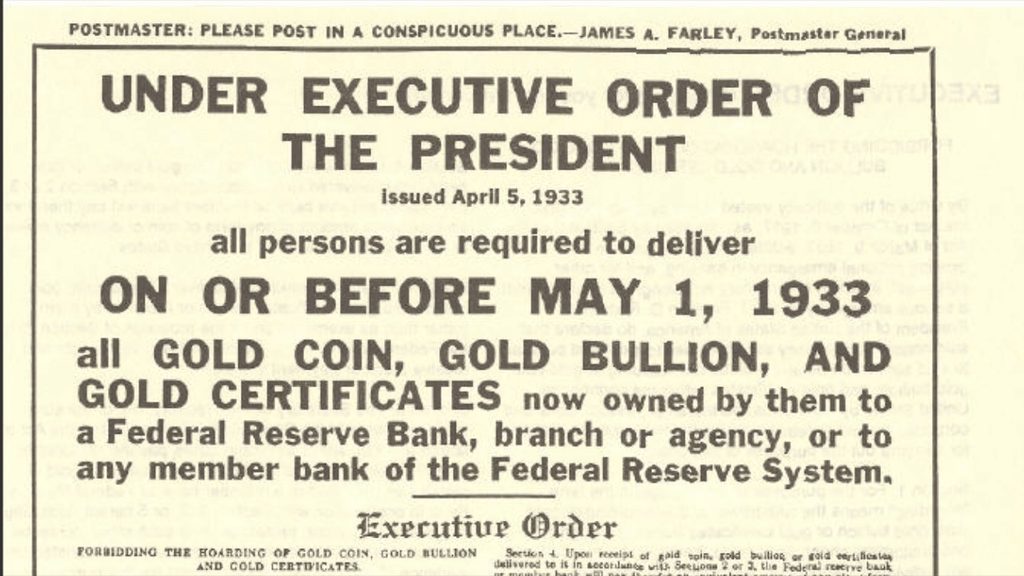
Once federal monetary control was established, gold’s remaining constraint was progressively removed. In 1933, Roosevelt’s Executive Order 6102 compelled citizens to surrender their gold for dollars at $20.67 per ounce, or face up to 10 years’ imprisonment and a $10,000 fine. The government subsequently repriced gold to $35 per ounce, devaluing all dollars by approximately 41%.
In 1944, the Bretton Woods Agreement promised foreign governments gold convertibility at $35USD/oz while their currencies were pegged to the dollar. However, continued US monetary expansion progressively weakened the dollar, prompting foreign central banks to redeem dollars for gold. Nixon responded by suspending gold convertibility in 1971, severing the dollar’s final link to gold. Since then, the US money supply has exceeded $23.22 trillion (July 2026), causing the dollar to lose over 97% of its value relative to gold. The United States now operates a purely fiat currency with no convertibility, commodity backing or fixed supply constraint.
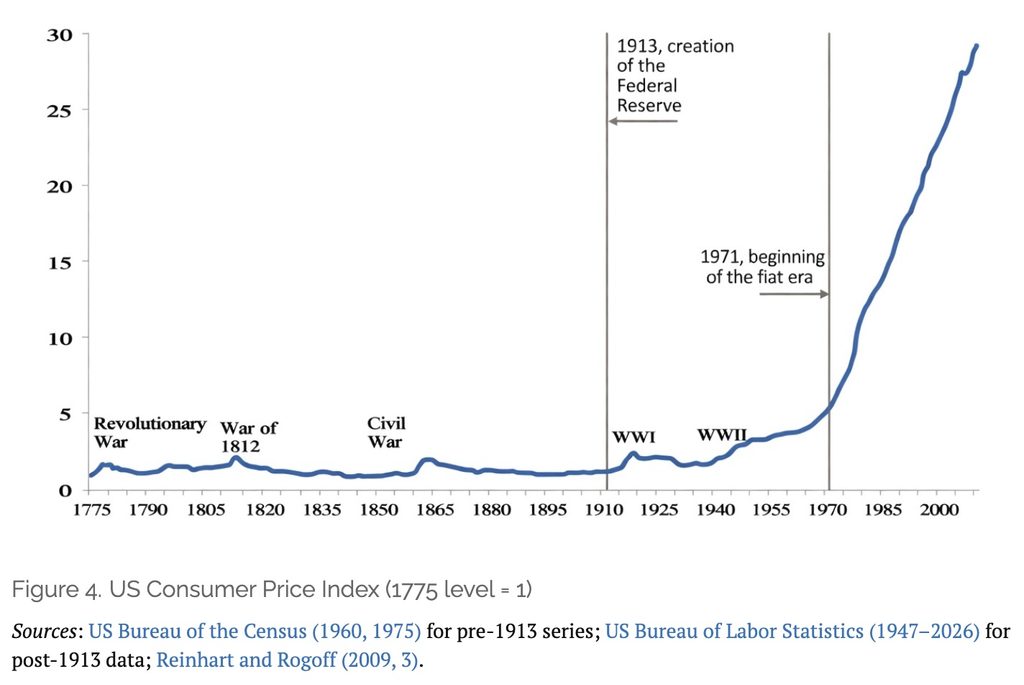
Given its extraordinary monetary expansion, why hasn’t the dollar already collapsed? Unlike previous fiat currencies, the dollar’s ‘world reserve currency’ status, cemented through Bretton Woods, has created enormous foreign demand for dollars and dollar-denominated assets. This effectively expanded the population of dollar holders, allowing the United States to continue printing money to pay for foreign goods and services. However, its ability to perpetually export inflation to the world depends upon continued global faith in the dollar. If individuals, businesses and governments increasingly migrate toward sound money, such as bitcoin, falling dollar demand could cause global demand for dollars to collapse. Despite its current dominance, the US dollar is not immune to hyperinflation; its fate has merely been delayed by globalising the economic base across which its debasement can be absorbed.
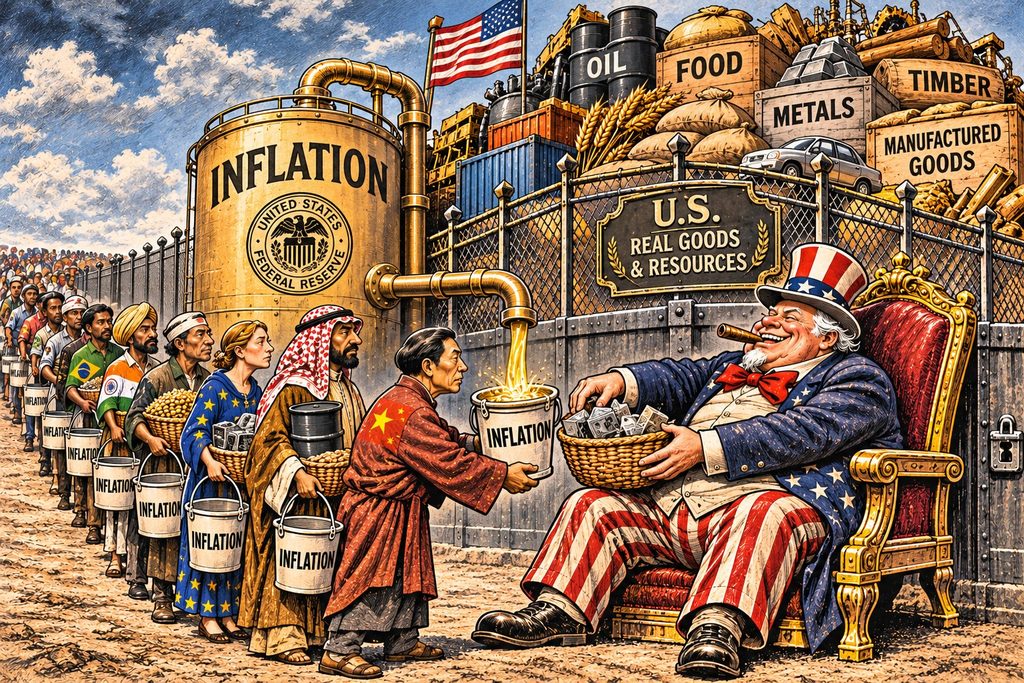
Because money is essential to large-scale human cooperation, its soundness has profound ethical consequences. When the state monopolises money, it restricts monetary choice and therefore individual liberty. When it debases that money, it silently steals the purchasing power of its citizens, violating their property rights and enriching politically privileged groups with the fruits of others’ labour. As previously argued, this concealed appropriation represents a subtle form of slavery that concentrates wealth and power while obscuring the extraction itself. At its extreme, monetary collapse can also threaten life through shortages, starvation, violence and social breakdown. State control over money therefore threatens all three natural human rights to life, liberty and property. Since these rights form the ethical foundation of peaceful civilisation, their systematic violation progressively undermines civilisational stability and have historically culminated in collapse, revolution or tyranny.

So how does bitcoin separate money from state? Whereas previous monetary reforms replaced one privileged issuer with another, bitcoin eliminates the issuer altogether. Its decentralised rules, absolute scarcity and globally distributed Proof-of-Work network prevent any government or institution from unilaterally expanding its supply or extracting seigniorage from its issuance. With no issuer to capture, bitcoin instead monetises from the bottom up as individuals voluntarily adopt it as a store of value, medium of exchange and ultimately unit of account. This is how sound money emerges: through voluntary market convergence upon superior monetary properties rather than coercion. As adoption grows, value can migrate from fiat currencies into bitcoin, weakening the extractive power states derive from controlling currency issuance. Governments may resist through regulation, capital controls and financial repression, but cannot unilaterally alter bitcoin’s supply or prevent its adoption globally. For the first time, monetary reform can occur organically, without any monetary authority, and on a global scale.

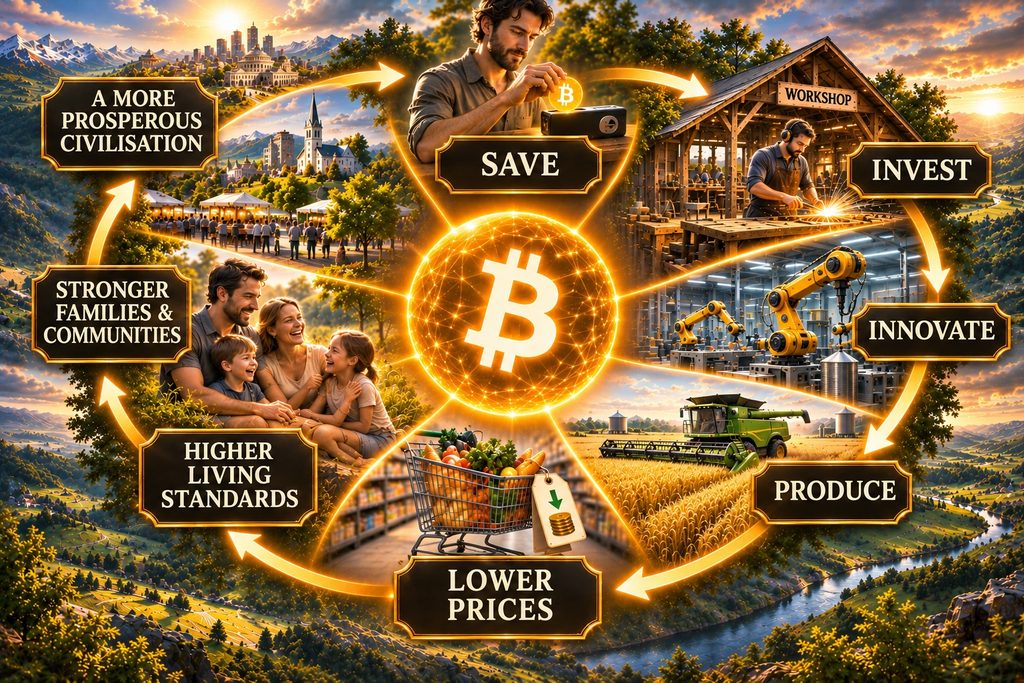
As bitcoin adoption grows, governments unable to fund themselves through currency debasement would become increasingly reliant on explicit taxation and genuine borrowing. Making the cost of government more transparent would impose greater fiscal discipline, placing pressure on waste, corruption and inefficient bureaucracy while increasing accountability to those funding it. Greater fiscal constraint could also expose poorly delivered public services to competition from private alternatives, reducing the resources and functions controlled by the state. Meanwhile, without inflation continually offsetting productivity gains, technological progress could express itself naturally through falling prices. Individuals could therefore retain more of their purchasing power while goods and services become cheaper. This would raise living standards and enabling longer-term planning, stronger families and communities, and more meaningful pursuits.
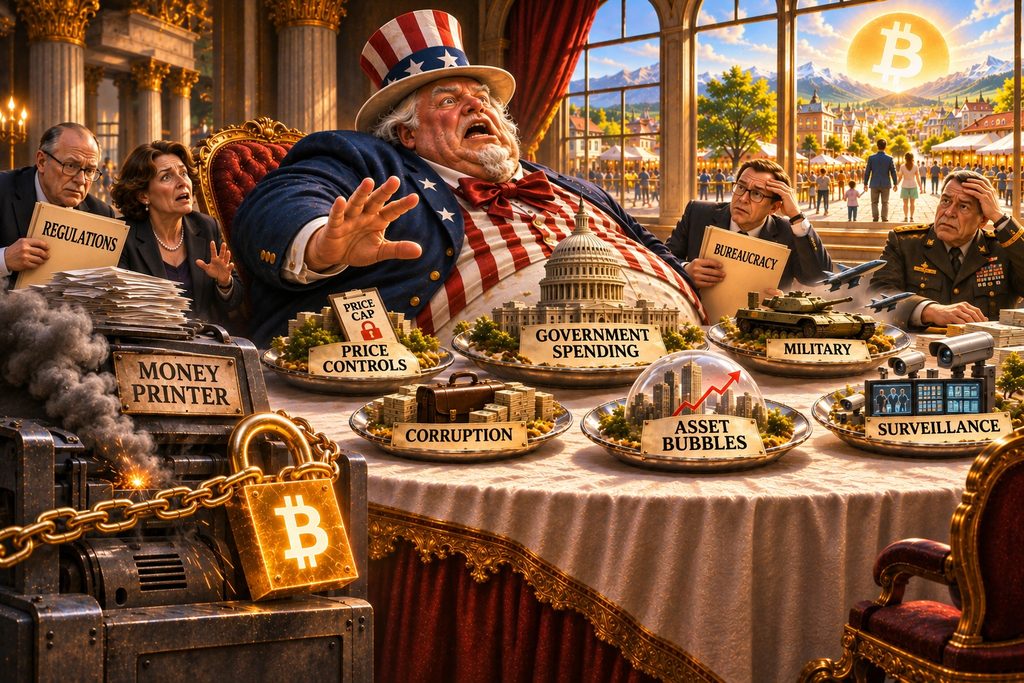
Contrary to the vicious cycle of monetary debasement and societal erosion enabled by fiat currencies, bitcoin creates a virtuous cycle of aligned incentives, individual responsibility and voluntary cooperation. Its decentralised rules eliminate the privileged issuer, protecting the fruits of human labour and imposing greater fiscal discipline on governments. Individuals are consequently better able to save, invest and plan further into the future, promoting capital formation, productivity and abundance. Bitcoin therefore offers humanity an escape from the recurring cycle of monetary capture, debasement and political exploitation. Just as the printing press weakened the monopoly over information and enabled the separation of church and state, bitcoin weakens the monopoly over money and may ultimately drive the separation of money and state.
Why Bitcoin?
Continue your learning by clicking the next section below (Bitcoin Promotes Civilisation).