
Preface
There are two opposing ‘schools’ of economic theory that are particularly relevant to understanding bitcoin; ‘Keynesian’ economics and ‘Austrian’ economics. This page offers a first-principles overview of economics through the Austrian lens. It provides the foundations necessary to critically evaluate the Keynesian economic orthodoxy, and better understand the case for bitcoin.
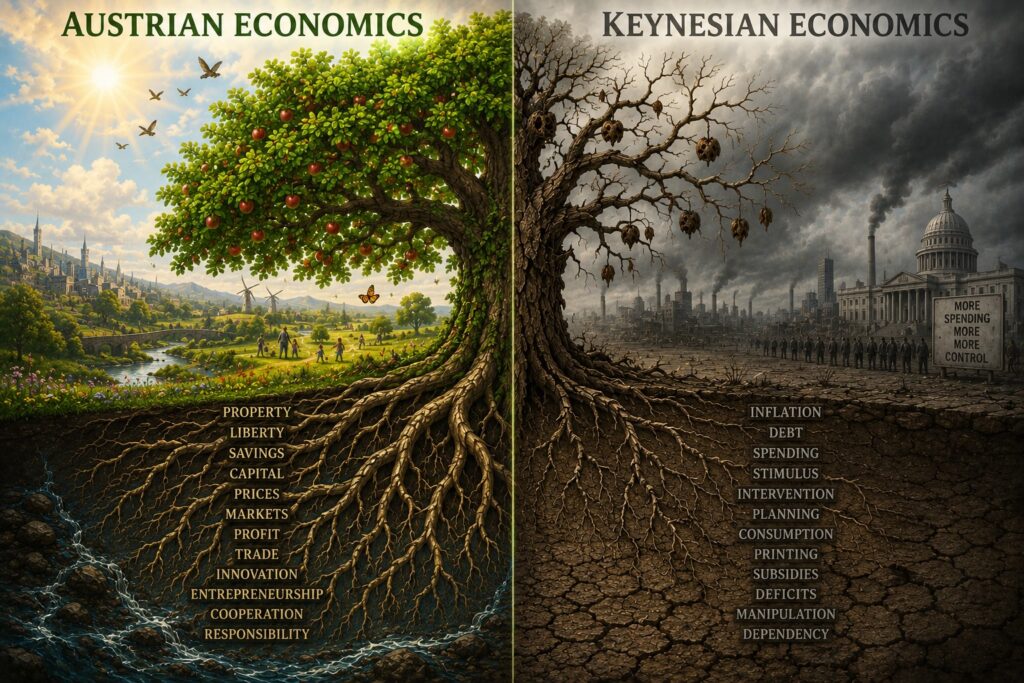
Keynesian economics, named after the British economist John Maynard Keynes, frames the ‘economy’ as a machine that requires active government management. It argues that economic growth and stability are best optimised through managed interest rates, a flexible money supply, taxation, and government spending. Most modern governments and economics textbooks today are heavily influenced by Keynesian ideas.
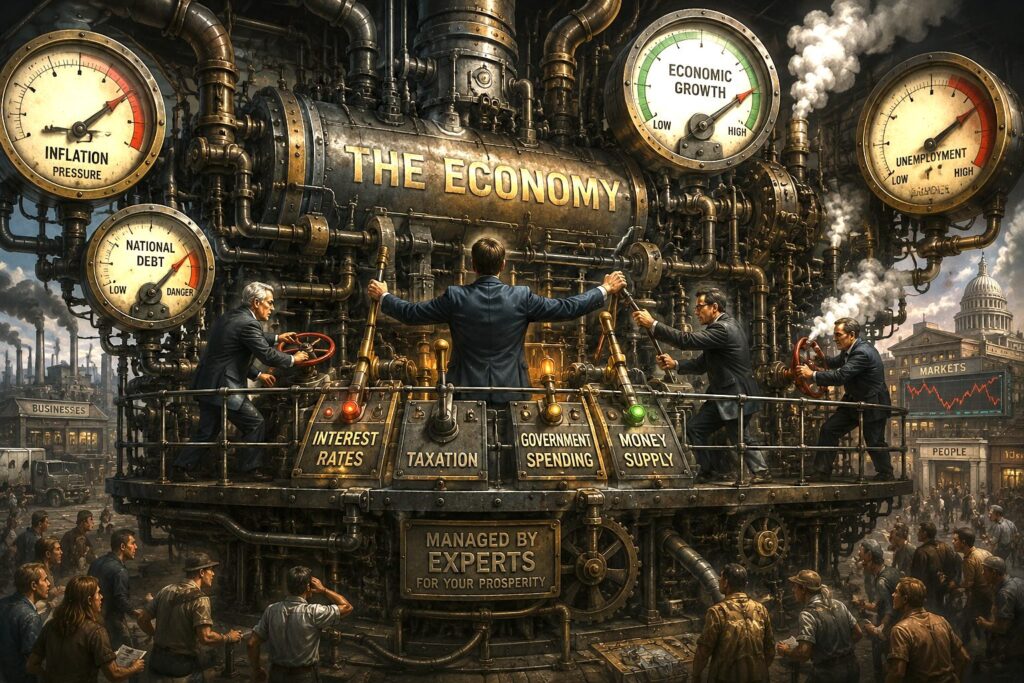
‘Austrian’ economics originated with Carl Menger and was later developed by Ludwig von Mises and Friedrich Hayek. Austrian economists view the economy not as a machine to be managed, but rather as the emergent result of countless individuals acting purposefully according to their own subjective values. They argue that markets are self-regulating processes of discovery, coordinating human action through prices, profit and loss. As such, Austrian economists generally warn against government interventions that distort these signals and produce unintended consequences.

In short, Keynesian economists support the idea of centrally managed economies running on fiat currencies, whereas Austrian economists advocate for free markets, limited government, and sound money.

Introduction
An economy is the emergent product of innumerable individual human choices, made at infinite scales of resolution, and across vast spans of time. Unlike the objective sciences (mathematics, chemistry, and physics), economics is not reducible to deterministic equations or the ‘scientific method’ of hypothetical experimentation. This is because the variables are practically infinite, impossible to control, and often subjective in nature. Instead, economics is best understood through ‘praxeology’ – the logical deduction of directional principles, distilled from in-situ observation of human behaviour. These directional principles are essential in understanding human action, trade, money, markets, civilisation and bitcoin.

The Principles
The starting point of economics is the observation that all humans act. Every action is an attempt to improve one’s situation, whether by satisfying a need, fulfilling a want, avoiding discomfort or pursuing a goal. Actions are therefore purposeful in directing available means toward satisfying desired ends.
However, the means to satisfying these ends are usually not superabundant. Time, energy, and resources are scarce, meaning every action is taken at the expense of alternative actions that could have otherwise been taken. This trade-off is known as ‘opportunity cost’.
In choosing between competing choices, individuals must rank potential outcomes according to their own subjective preferences, and direct their means toward achieving their most desired ends. Economics is therefore the study of purposeful human action under conditions of scarcity.

Since every action requires a choice, and carries with it opportunity cost, an individual must first decide which potential outcome they prefer. Such preferences arise out of the subjective value an individual places on the expected outcomes of their actions.
For example, when making a purchasing decision, a rational person will generally select the good they believe will provide the greatest satisfaction relative to its opportunity cost. Implicit in that choice is the judgement that the chosen good is valued higher than the alternatives.
Therefore, value is not intrinsic to the good or service itself, but rather it is the subjective assessment of the utility an individual expects to derive from it. Since different people have different needs, wants, priorities and circumstances, the same good can be valued very differently by different individuals.
Contrary to theories of ‘intrinsic value’, Austrian economists argue that ‘value’ exists only in the mind of the individual. It is this principle of subjective value that underpins all human action, trade, prices, and economic reasoning.

Because value is subjective, individuals naturally rank their preferences ordinally (in order of better to worse), rather than evaluating options based on objective units of value. Since preferences differ between individuals, there is no universal scale by which those preferences can be measured across multiple individuals.
It is this principle that enables mutually beneficial exchange between individuals, also known as free trade. Such a trade can only occur when both parties believe they will benefit from it. Implicit in a voluntary trade is that each person values the good they received more highly than the good they gave up. If value were objective and inherent to the goods themselves, voluntary exchange wouldn’t be beneficial or necessary.
The same is true when transacting with money. When purchasing a good, the prospective buyer must first decide that they value the good more than the amount of money being exchanged. Conversely, in setting the price of the good the seller is expressing that they value that amount of money more than the good offered for sale.
‘Price’, therefore, cannot be an objective measure of ‘value’ since it overshoots it for the seller, and undershoots it for the buyer. Instead, price is merely a language through which buyers and sellers can express their individual preferences based on their own subjective values.
Since value exists in the minds of individuals, there can never be an objectively “correct” price for any good or service. Rather, price is naturally found through voluntary exchange – where demand meets supply. Therefore, any attempt to impose artificial prices through government intervention only distorts these signals and inevitably creates demand-supply mismatches (shortages or surpluses).

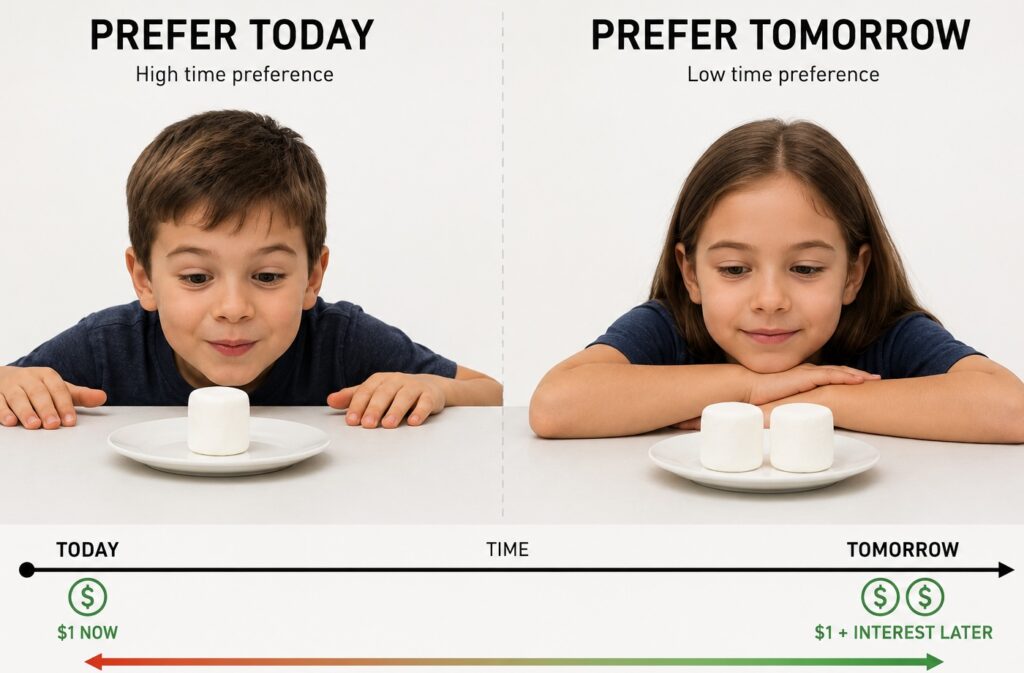
Time is simultaneously the universal input to all economic activity, and also humanity’s scarcest resource. Unlike most resources, time cannot be produced, recovered, or stored. Furthermore, as someone ages, the amount of time they have remaining decreases. Because humans are aware of this reality, they naturally prefer satisfaction sooner rather than later. This universal tendency is known as ‘time preference’.
The degree to which an individual prefers present satisfaction determines the magnitude of their time preference. Someone with a higher time preference is more present-oriented, and more likely to favour immediate consumption. Conversely, someone with a lower time preference is more future-oriented, and more willing to defer gratification. Regardless of the magnitude, however, human time preference is always ‘positive’, meaning satisfaction today is generally valued more highly than the prospect of the same satisfaction deferred until tomorrow.
Therefore, for anyone to postpone consumption, they must expect a sufficiently greater reward in the future to compensate for the sacrifice made in the present. For example, a farmer may choose to plant a grain rather than consume it because he expects it to produce many more grains in the future. In doing so, he is sacrificing immediate consumption in service of increased future satisfaction.
As an individual’s immediate needs become more secure, their time preference tends to fall. As their time preference falls, they are more likely to save, invest, plan and specialise, all of which allow civilisation to advance. Conversely, anything that artificially raises society’s time preference by incentivising present consumption at the expense of future production, necessarily reduces savings and investment, and undermines economic prosperity.

Because time and resources are scarce, individuals have a strong incentive to use them as efficiently as possible. Rather than attempting to produce everything they need themselves, people naturally gravitate toward the forms of work that best suit their skills, knowledge, and circumstances. This process is known as specialisation.
By specialising, an individual can produce more value than they otherwise could on their own. A carpenter, for example, can build furniture more efficiently than a farmer, while a farmer can produce food more efficiently than a carpenter. Rather than each attempting to do both jobs poorly, both become more productive by focusing on what they do best and trading with one another.
This specialisation gives rise to the division of labour, whereby individuals, businesses, and entire industries focus on specific productive activities. Through voluntary exchange, each participant can then obtain the goods and services produced by others at a lower opportunity cost than if they had attempted to produce them themselves. As a result, all parties benefit from trade.
When division of labour occurs throughout society, productivity increases dramatically. Greater productivity allows more goods and services to be produced with the same inputs of time and resources, raising living standards and enabling economic growth. Civilisation itself is largely the product of this process. Any attempt to direct labour away from where it would naturally flow undermines specialisation, reduces productivity, and ultimately lowers economic prosperity.

Property rights arise naturally from the reality of scarcity. If all desirable goods were superabundant, there would be no conflict over their use or possession. However, because scarce resources cannot be simultaneously controlled by multiple people, a system of property rights emerges as a means of peacefully allocating control and resolving conflict.
Property rights provide individuals with exclusive authority over the fruits of their labour, voluntary exchanges, and accumulated possessions. Without the expectation of continued ownership, there would be little incentive to produce, trade, save, or invest. Why sacrifice consumption today to build something for tomorrow if it could simply be taken from you?
Secure property rights create confidence in the future. Once individuals can reasonably expect to retain what they produce and acquire, they gain an incentive to save rather than consume everything immediately. Savings can then be invested into better tools, skills, businesses, and other forms of capital that increase future productivity.
When this process occurs across an entire society, saving leads to investment, investment leads to greater productivity, and productivity raises living standards. In this way, property rights form one of the essential foundations of capital accumulation, economic progress, and civilisation itself. Conversely, any systematic erosion of property rights weakens the incentive to save, invest, and produce, reducing long-term prosperity and undermining the foundations upon which civilisation is built.

Once an individual’s immediate needs have been met, and assuming their property rights are secure, they may choose to defer some consumption and save for the future. These savings can then be invested into assets that increase future productivity. Such assets are known as ‘capital goods’.
Capital goods are not primarily consumed for their own sake. Rather, they are used to produce other goods and services more efficiently. A fisherman, for example, may be able to catch only a handful of fish each day with his bare hands. By first saving and then investing in a fishing rod, he can dramatically increase his future output. Greater productivity may then allow him to acquire even more advanced capital goods, such as a boat, further increasing his production.
Implicit in every investment is a sacrifice of present consumption in exchange for greater future production. The process of acquiring and improving capital goods over time is known as ‘capital accumulation’. Because capital allows more output to be produced with the same inputs of labour and resources, capital accumulation is one of the primary drivers of rising living standards.
When capital accumulation occurs across an entire society, productivity compounds. Better tools, machinery, infrastructure, education, and technology allow each generation to produce more than the last. This process underpins economic growth, technological advancement, and civilisation itself.
The idea of ‘capitalism’ is the recognition that free trade, secure property rights, and private capital accumulation provide the most effective means yet discovered for increasing productivity and improving human well-being in the face of scarcity. The more a society allows these processes to operate freely, the greater its capacity for long-term prosperity.

Human wants are effectively unlimited, while time and resources remain scarce. As a result, individuals are constantly incentivised to discover better ways of satisfying more wants with fewer inputs. One of the most powerful ways to achieve this is through innovation.
Innovation is the discovery and implementation of new ideas, methods, or tools that increase productivity. Technology is simply the practical application of those innovations. At its core, technology enables humans to produce more output with less labour, time, or resources than would otherwise be possible.
Consider the fisherman from the previous example. Catching fish by hand is less productive than using a fishing rod, and a fishing rod is less productive than a fishing vessel. Each technological improvement increases the fisherman’s output per unit of effort, allowing him to satisfy more of his wants through trade and exchange.
In a free market, technologies are subjected to a continual process of natural selection. Innovations that create more value than they cost to implement tend to be adopted and expanded. Those that fail to improve productivity are eventually abandoned. Profit and loss therefore serve as a feedback mechanism that helps direct resources toward the most productive innovations.
As new technologies accumulate, they can be combined with existing technologies to create even greater gains in productivity. The history of civilisation is largely the story of this compounding process. Better tools lead to better production, which enables further innovation, creating a virtuous cycle of rising productivity, technological advancement, and increasing living standards.

When individuals are free to act, specialise, trade, save, invest, and innovate, their productivity increases. As productivity rises, more goods and services can be produced with the same inputs of labour, time, and resources.
This increase in productivity raises living standards by allowing a greater quantity of human needs and wants to be satisfied. Put differently, either the same standard of living can be maintained with fewer hours of labour, or a higher standard of living can be achieved with the same amount of labour. In both cases, the real cost of satisfying human needs and wants has fallen.
This continual reduction in real costs creates deflationary pressure within an economy. In a barter economy, this manifests as an increasing abundance of goods and services. In a monetary economy, it tends to manifest as falling prices and increasing purchasing power.
Technological progress provides countless examples of this process. A modern smartphone performs the functions of a camera, map, calculator, encyclopedia, music player, telephone, television, and computer at a fraction of the cost that purchasing those items separately would have required only a few decades ago. Similar productivity gains can be observed throughout most of human history.
From the Austrian perspective, productivity-driven deflation is not a sign of economic weakness, but rather evidence that civilisation is becoming more efficient at satisfying human wants. All else being equal, as productivity compounds over time, goods and services become increasingly abundant, living standards rise, and the purchasing power of money tends to increase.

As explained in the article What Is Money?, money predates governments and is therefore not fundamentally a state invention. Rather, money emerges naturally whenever individuals engage in voluntary exchange and discover that certain goods are more marketable than others.
Throughout history, many goods have been used as money, including salt, grain, shells, livestock, and precious metals. Over time, market participants naturally gravitated toward whichever good best performed the three functions of money: store of value, medium of exchange, and unit of account. The goods that most effectively satisfied these functions were ultimately adopted more widely, while inferior forms of money were gradually abandoned.
This process of monetary selection is analogous to a form of economic natural selection. Just as businesses compete to satisfy consumers, potential monies compete to fulfil the monetary role within a marketplace. The goods possessing the strongest monetary properties (divisibility, durability, portability, recognisability, and scarcity) tend to outcompete alternatives over time.
Historically, gold emerged as the dominant monetary good because it performed the monetary functions more effectively than competing alternatives. Importantly, gold became money long before it was adopted by governments. States did not create gold’s monetary role; rather, they adopted and later built monetary systems around a money that markets had already selected.
From the Austrian perspective, money is therefore not an imposed top-down invention, but rather an emergent ground-up phenomenon. Like language, law, prices, and markets themselves, money arises spontaneously through human cooperation and voluntary exchange. This insight is particularly important when evaluating competing forms of money such as gold, fiat currency, and bitcoin.
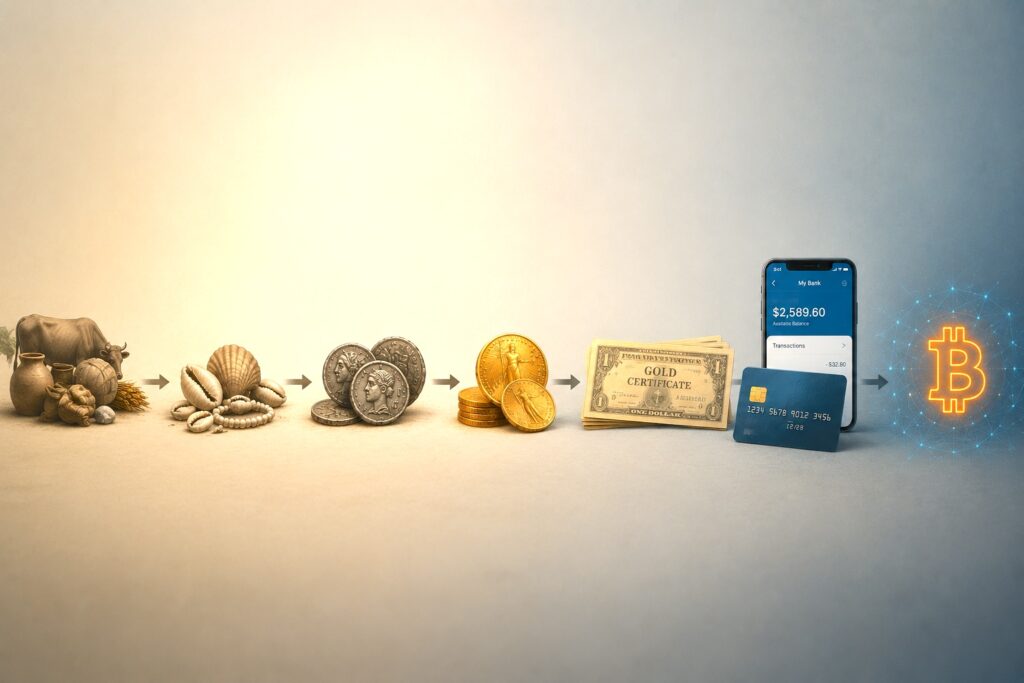
Fiat currencies differ fundamentally from all previous forms of money in that they are imposed, not voluntarily selected. The coercion necessary to ensure their use is not in dispute; the term ‘fiat’ literally means ‘by decree’. Governments demand taxes to be paid in their fiat currency, designate it as the only legal tender for settling debts, and enforce its use through the legal system.
From a first-principles perspective, any money that emerges naturally through voluntary selection, does so because it benefits all market participants equally. The opposite therefore, must be true; if a currency must be imposed through coercive measures, it likely benefits some market participants to the detriment of others. Since legal compulsion accompanies all fiat currencies, the question of who it disproportionately benefits naturally arises.
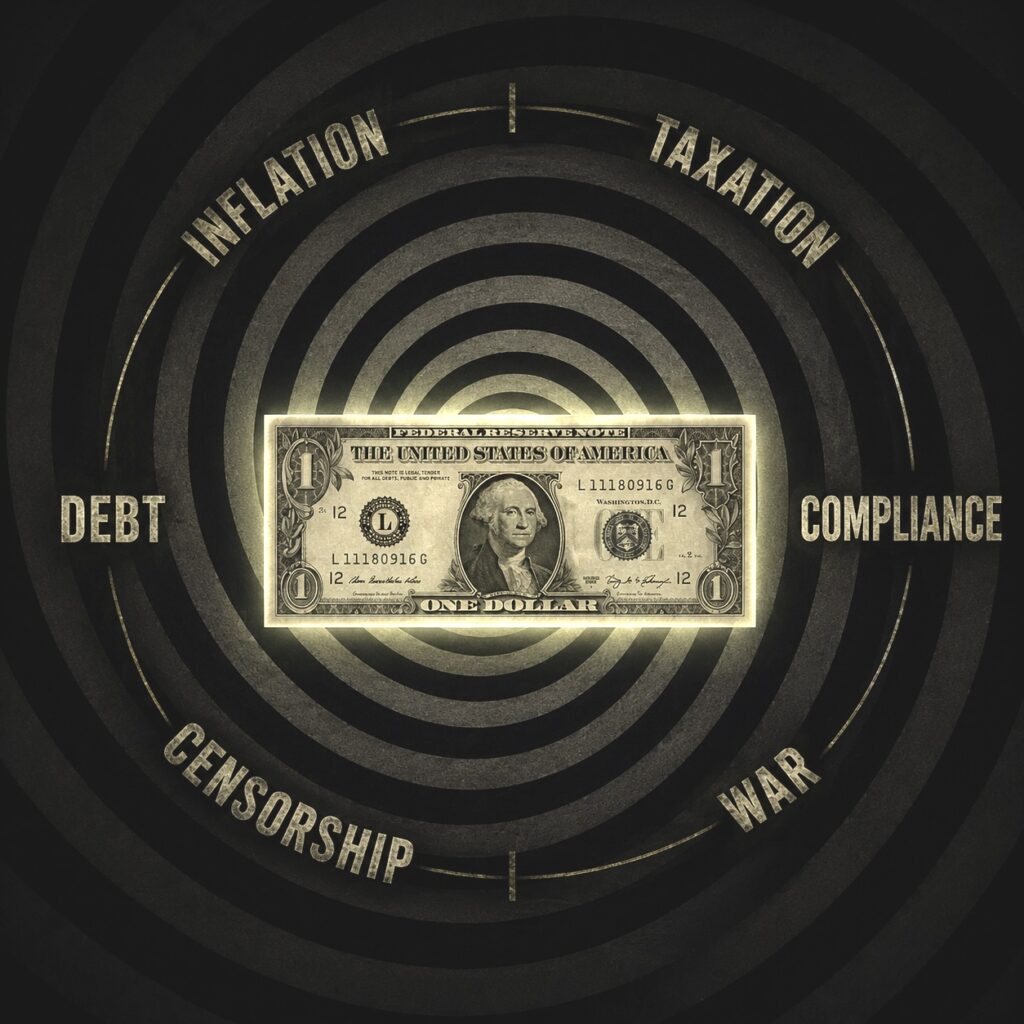
Unlike commodity monies, fiat currencies possess no hard supply constraint. New units can be created at negligible cost by central banks and commercial banking systems, granting their issuers privileges unavailable to ordinary market participants. This creates an inherently unequal monetary system in which some actors gain access to newly created money before others, while everyone else sees their purchasing power get diluted through monetary expansion (inflation).
From the Austrian perspective, fiat currency is therefore not an emergent or ‘sound’ money, but rather a politically privileged one. Whereas gold became money because people voluntarily chose to hold and exchange it, fiat currencies persist primarily because states mandate their use. In this sense, fiat money represents a deviation from the market process that historically gave rise to money itself.
An economy is the emergent result of the actions of its most reducible units, the individuals. Every individual possesses unique knowledge about their own needs, preferences, resources, and circumstances. Much of this information is local, subjective, and impossible for anyone else to fully observe or measure. Because such knowledge is dispersed across millions of individuals, no central authority can ever possess all of the information required to efficiently direct an economy.
When individuals are free to buy, sell, save and invest, this information is naturally compressed and revealed to the market through their actions. The collective decisions of all freely-acting individuals are what drives the process of ‘price discovery’. Far from being arbitrary numbers, prices are vital signals that dynamically communicate relative scarcity, demand, and opportunity costs throughout an economy.
Undistorted price signals are essential to the continual feedback mechanism of profit and loss. Individuals who successfully anticipate and satisfy the wants of others are rewarded with profits, while those who use resources less effectively incur losses. This process dynamically incentivises the direction of scarce resources toward their highest-valued uses and away from less productive uses.
The dynamic interplay between natural price discovery and profit incentives is what gives free markets their inherent capacity for self-correction. Shortages, surpluses, and inefficiencies create opportunities for entrepreneurs to earn profits by resolving them. In this way, markets constantly adapt to changing conditions without requiring central direction.
Attempts to centrally manage an economy interfere with these natural communication and incentive feedback mechanisms. Price controls, subsidies, mandates, and other interventions distort the signals that market participants rely upon to make rational economic decisions. Austrian economists therefore argue that economic inefficiencies are likely to be more frequent, more pronounced, and more persistent, when markets are prevented from adjusting freely than when they are allowed to self-correct.

In simple terms, interest rates are the market price of exchanging money today for money tomorrow. They emerge naturally due to differences in time preference between prospective borrowers and lenders. All else being equal, borrowers value present money more than future money, whereas lenders value future repayment more than present spending. Interest is the premium, paid by the borrower, to compensate the lender for the opportunity cost of deferring present consumption.
In a free market, borrowers are incentivised to seek the lowest interest rates, while lenders seek the highest returns. As borrowers compete with each other for available loans and lenders compete with each other for willing borrowers, interest rates will emerge naturally through the same process as price discovery. A society with a high time preference will tend toward higher interest rates, whereas a society with low time preference will tend towards lower interest rates.
Since interest rates are a function of human time-preference, they cannot be arbitrarily changed (eg. via policy) without causing unnatural borrowing, consumption, and investing behaviour. This is because doing so distorts the natural price signal between prospective borrowers and lenders. For example, pushing interest below market rates will create excess demand for credit, whereas raising interest above market rates will create an excess in the supply of credit. Any policy rate that differs from the market rate will create a mismatch between the demand and supply for credit.
Under a scarce money standard such as gold or bitcoin, these mismatches would cause lending activity to stall until rates returned to their natural market level. Therefore, governments can only maintain artificial interest rates if they impose a fiat currency, and grant themselves the power to expand and contract the supply of money.
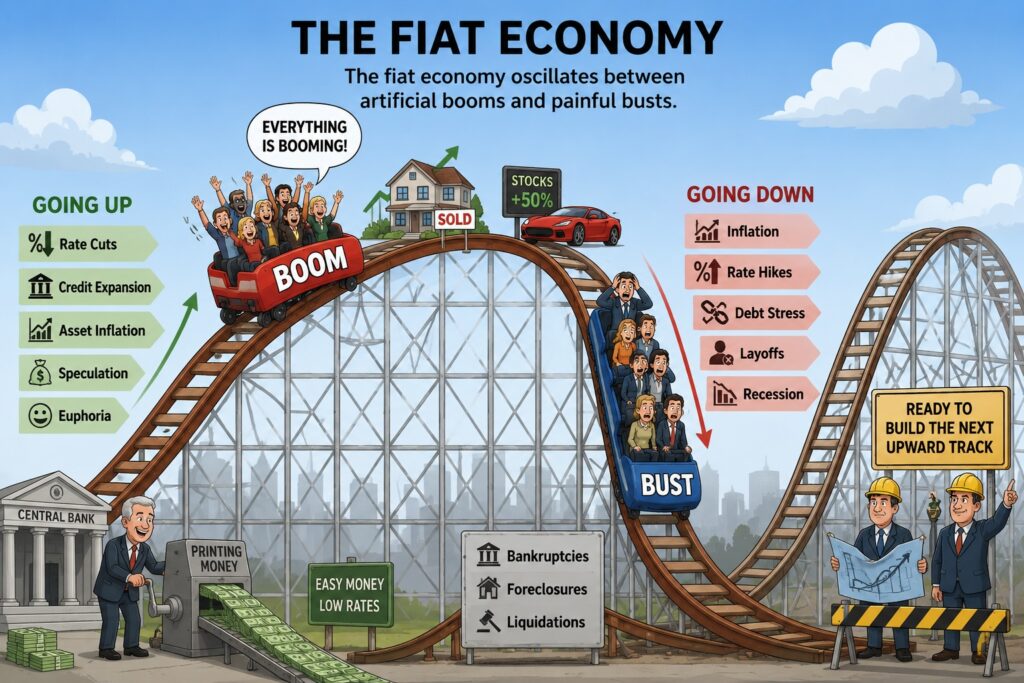
Virtually all modern governments operate on fiat monetary systems that enable the expansion and contraction of the currency supply. Following Keynesian economic doctrines, policymakers typically target an arbitrary level of inflation (eg. around +2%), which they insist is required for economic growth and stability. They pursue this inflation target by suppressing interest rates and expanding credit. However, because interest rates are a market signal reflecting society’s time preference, artificially lowering them distorts economic decision-making.
When interest rates are suppressed and credit is allowed to expand, borrowing and lending become artificially attractive. Consumers increase spending, businesses scale in ways that previously appeared uneconomic, investors settle for lower-yielding assets, and banks increase their lending. The result is an economy-wide increase in borrowing, spending, and leverage.
Initially, this credit expansion creates the appearance of prosperity. Asset prices rise, economic activity accelerates, and employment grows. However, this apparent boom is driven by increased consumption and investment without a corresponding increase in real savings or productivity. Resources are increasingly directed toward projects that only appear viable because credit is artificially cheap. Austrian economists refer to this misallocation of resources as ‘malinvestment’.
As newly created currency floods the market, demand begins to outpace the economy’s ability to produce goods and services. This excess demand causes relative shortages in the marketplace, which in turn drives up prices. As prices rise, inflation accelerates and overshoots the government’s stated target. Policymakers often respond by tightening credit and raising interest rates, reversing the artificial conditions that initially fuelled the boom.
As credit tightens, individuals and businesses react by cutting costs, causing aggregate demand to collapse. Additionally, malinvestments that appeared economic during the boom are revealed to be unsustainable and need to be unwound. Capital intensive projects run out of funding and are halted or abandoned, adding to unemployment. Finally, as asset prices fall, leveraged investments are liquidated, and bankruptcies increase.
The resulting recession is the ‘bust’ that inevitably follows the ‘boom’. During this time, basic living costs remain high, and living standards within society decline. As the recession extends, inflation eventually falls back below the government’s target, giving policymakers reason to ‘stimulate’ the economy again. They do this by lowering interest rates again and allowing currency expansion to resume, recreating the conditions that caused the previous boom, and setting the stage for the next cycle.
From the Austrian perspective, the recurring boom-bust cycles characteristic of modern economies are not failures of free markets, but the consequence of manipulating money and interest rates. By interfering in the market’s most important price signal, the ‘time value of money’, governments create the very instability they claim to manage. Without fiat currency, the state would not have this ability, and the seeds of a ‘business cycle’ could not be sown.
Every economic decision involves a choice between competing uses of scarce resources. Should a farmer plant wheat or corn? Should a builder construct houses or factories? Should an entrepreneur invest in one project rather than another? Since resources are limited, every choice carries an opportunity cost.
In a complex economy, these decisions cannot be made through intuition alone. Instead, individuals rely upon prices to compare alternatives and estimate whether a particular action is likely to create or destroy value. Prices therefore act as an information system, helping coordinate economic activity across millions of independent actors.
However, prices are only useful if they can be expressed in a common unit of account. This role is performed by money. Money is therefore far more than a medium of exchange; it is the measuring stick by which economic decisions are evaluated. Every business plan, investment decision, profit calculation, and financial forecast ultimately depends upon it.
If the measuring stick itself is constantly changing, economic calculation becomes increasingly unreliable. A builder may struggle to determine whether rising prices reflect genuine demand for housing or merely currency debasement. An entrepreneur may mistake easy credit for genuine savings. An investor may be unable to distinguish productive opportunities from speculative bubbles. In each case, resources become more likely to be directed toward less productive uses.
This problem becomes especially severe when money can be created without a hard constraint. Artificial changes in the supply of money distort prices, interest rates, profits, and losses, undermining the very signals that individuals rely upon to make economic decisions. As these signals become increasingly corrupted, economic calculation becomes increasingly difficult, leading to greater misallocation of capital and reduced productivity.
Sound money alleviates this problem by providing a stable and reliable monetary foundation upon which economic calculation can occur. When money cannot be easily manipulated, prices more accurately reflect underlying economic realities, allowing individuals and businesses to make better long-term decisions. Capital can be allocated more efficiently, savings can be preserved, and productive investments become easier to distinguish from unproductive ones.
From the Austrian perspective, civilisation itself is ultimately a coordination problem. The more accurately individuals can calculate, plan, save, invest, and cooperate, the more prosperous society becomes. Sound money therefore does not merely facilitate trade; it serves as one of the foundational information systems upon which advanced civilisation depends.

Conclusion
Austrian economists believe that human flourishing begins with the rights to life, liberty, and property. When individuals are free to act according to their own values, they are incentivised to cooperate, specialise, trade, save, invest, and innovate. These behaviours increase productivity, enable capital accumulation, and gradually transform scarcity into abundance. As productivity compounds, living standards rise, time preference falls, and civilisation advances.
Austrian economists therefore view economic prosperity as the natural consequence of sound incentives and voluntary cooperation. Conversely, they argue that interventions which distort prices, property rights, money, or interest rates, necessarily disrupt this process. Over time, these distortions lead to malinvestment, reduced productivity, recurring boom-bust cycles, and a gradual erosion of living standards. In this view, the instability characteristic of modern fiat economies is not a failure of free markets, but a consequence of interfering with them.
If sound money is necessary for accurate economic calculation, and economic calculation is necessary for civilisation, then identifying the soundest form of money becomes one of the most important questions society can ask.
Bitcoin embodies many of the principles explored throughout this article. It is scarce, voluntary, decentralised, and resistant to manipulation. Unlike fiat currency, it cannot be created at will or used to distort interest rates and credit markets. For this reason, many view Bitcoin not merely as a new form of money, but as a return to the economic principles that historically enabled human prosperity.
Bitcoin is best understood as an attempt to restore sound money, reliable economic calculation, and fundamental human rights to a world built upon fiat currency.

Bitcoin First Principles
Continue your learning by clicking the next section below (Philosophy & Ethics).
Leave a Reply