
Introduction
Before we can determine whether a monetary system is good or bad, we must first determine what ‘good’ and ‘bad’ actually mean. Before we can determine how humans should organise themselves, we must first understand what fundamental rights must be navigated. This section steps back from economics and reasons upward from the most fundamental aspects of human existence, to derive the ethical principles upon which peaceful cooperation, human flourishing, and ultimately money itself depend. Without an ethical framework, it is impossible to know by what standard a monetary system should be judged, or have any hope of identifying and overcoming one which is harmful to society.
Part 1 – Acknowledging Reality
The fundamental starting point of any philosophical framework is the recognition that reality exists. At the very least, the concept of ‘I’ exists as a consciousness. Regardless of the objective substrate of reality itself, your conscious experience of reality undeniably exists. Implicit in your consciousness is the experience of emotions, sensations, thoughts, and relationships with things and people around you. Your conscious intelligence perpetually converts incoming stimuli into thoughts and actions, which invariably shape your experience of reality. Only once the reality of existence is acknowledged, can any ground-up reasoning of ethics or morality be undertaken.

The next step is to realise that your consciousness is not the only one in existence. Whilst it is impossible to prove that those around you are truly conscious, everyone you encounter exhibits the same signs of consciousness which you observe in yourself. Just like you, other people appear to have thoughts, emotions, ambitions and memories, as well as engage in deliberative action. Therefore it is reasonable to assume that other people are unique nodes of consciousness just as you are. Moreover, the downside risk of treating others as if they are not conscious individuals, and being wrong, is extremely high. Doing so reliably produces suffering and is experientially less desirable than the alternative. As such, all ethics are predicated upon the assumption that other people exist and possess consciousness just like you.

If you accept that you are a conscious being then the act of navigating reality is an inescapable part of your existence. You don’t merely observe the world, you act within it. Part of being conscious is the ability to process incoming stimuli and take action. It is impossible to avoid the action that follows stimulus, since even choosing not to react is, in itself, an action. Therefore, to be ‘conscious’ is to experience oneself as an ‘actor’, imbued with agency, and always directing your behaviour. Even those who deny the existence of agency, are first required to evaluate competing theories, choose a position, and intentionally communicate that conclusion, all of which are acts of agency. Even in coercive situations where available options are artificially limited, an individual can always make the choice to take no action. In choosing to do nothing they are still manifesting agency. Likewise, even a slave who is forced to work against his will can choose not to and suffer the consequences. In this manner, agency exists, even when liberty is curtailed. All human ethics and social institutions are predicated on the existence of agency.

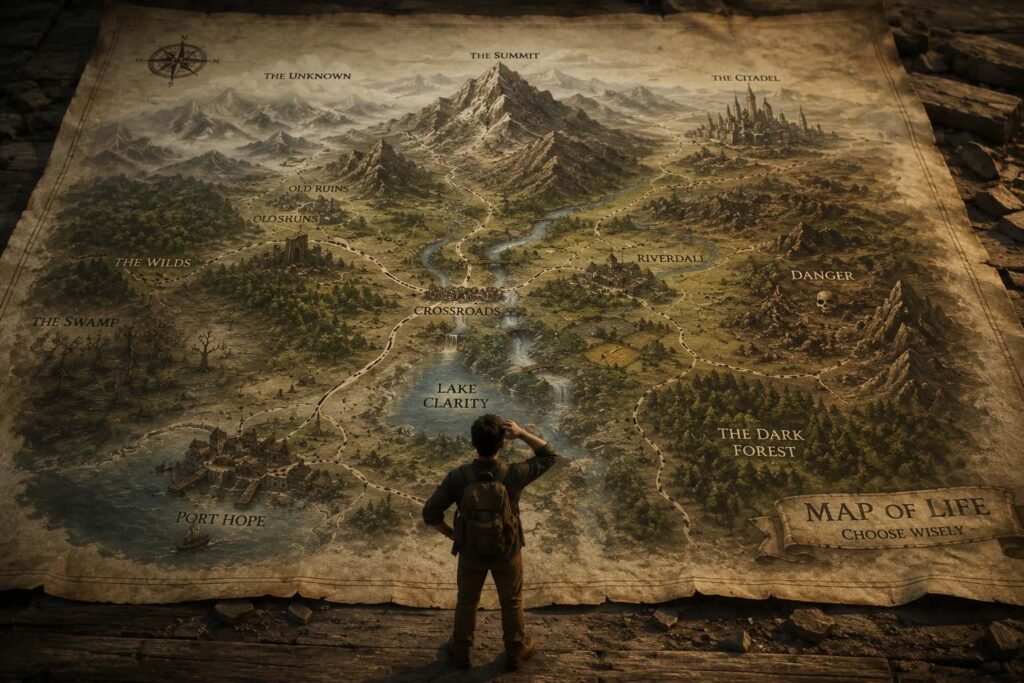
How reality unfolds in front of you is not arbitrary and its constraints on you are indifferent to your beliefs or preferences. Therefore, successfully navigating reality requires a map with sufficient fidelity to guide you and help avoid unnecessary suffering. The fidelity of the map is determined by how faithfully it matches reality. Conversely, having a map that incorrectly describes the landscape is counterproductive and likely to invite pain, frustration, and suffering. The common phrase, ‘facts don’t care about your feelings’, can sound harsh, but reality nevertheless imposes its consequences regardless of your beliefs. For example, if you believe poison is food, enemies are friends, and the laws of physics don’t apply to you, reality will punish you accordingly. Truth, therefore, not only exists, but recognising it is a prerequisite for navigating existence successfully. The more representative the map is of the territory, the more truth it contains, and the more useful it will be. Importantly, truth differs from information in that truth is qualitative and directional, whereas information is quantitative and distinct. For example, a map can still be ‘true’ even if it leaves out unnecessary detail, whereas a false map remains untrue regardless of how detailed it is. Therefore, he who denies objective truth has a false map and is subsequently aimless and lost.
One inescapable truth of reality is the existence of scarcity. Regardless of one’s personal beliefs, time, life, energy, and resources, are all limited. Since human beings are mortal, and life-sustaining resources are scarce, choices must be made. Every choice implies a trade-off, or ‘opportunity cost’, which is the deliberate sacrifice of all other options in service of the chosen path. Scarcity even exists in more abstract domains. For example it is impossible to be in two locations at once, or hold two opposing beliefs simultaneously. Therefore even in the most basic acts of moving and thinking, scarcity forces us to make sacrifices. It is self evident that if all our desires could be satisfied at all times, then no sacrifice would not be necessary. Therefore, in simply acknowledging that you have personal desires, you are proving that scarcity exists. With scarcity comes the possibility for conflict, and therefore the need to ethically resolve it. Acknowledging the existence of scarcity, therefore, is to recognise the need for human ethics.

Because of scarcity, some degree of suffering is obligatory. Suffering is perhaps the most self-evident aspect of life because it is experienced by everyone directly. Hunger, thirst, fear, grief, pain, loss, and loneliness are modes of potential suffering that virtually every human faces. Even the nihilist who claims meaning, purpose, and objective value don’t exist, still recoils from having his hand placed on a hot stove. He, like everyone else, instinctively knows that not all suffering is necessary or productive. For example, when pain is downstream of malice, negligence, or imposition, then that suffering is unnecessary and unproductive. However, when individual suffering is downstream of one’s own sacrifice, made in service of a goal, then that suffering may actually be necessary and productive. Regardless of its origin, the reality of suffering provides a solid foundation for understanding what matters to human beings, and for creating a framework for human ethics.

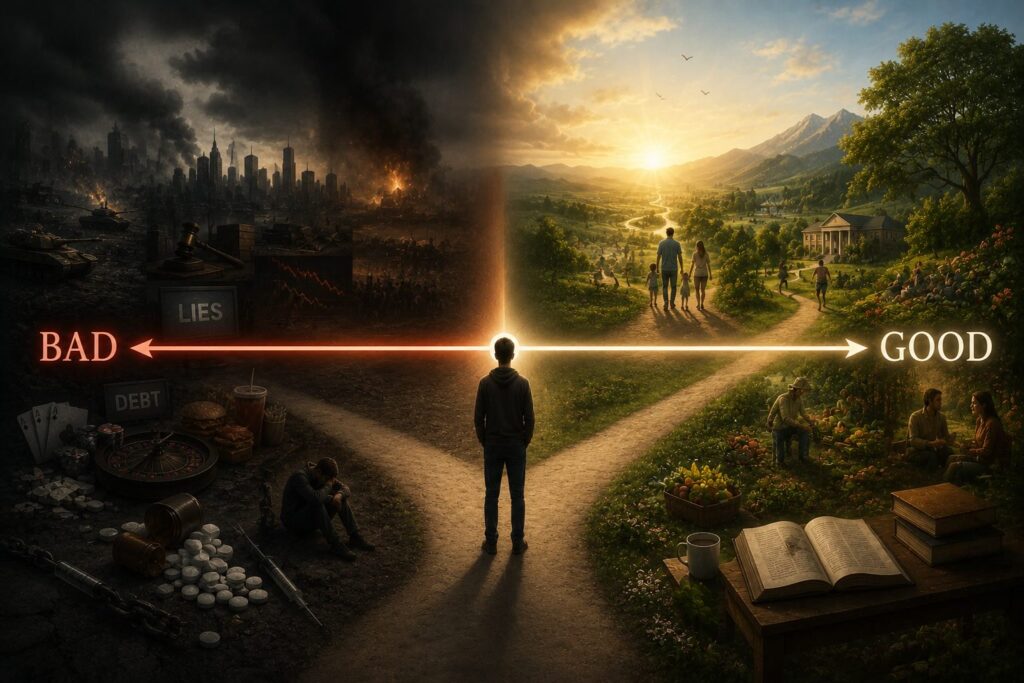
If suffering exists, and conscious actors universally seek to minimise it, then reality itself must contain directionality and value. It is directional in that you deliberately withdraw from sources of unnecessary suffering, and in so doing you reveal what you value. For example, all else being equal, joy is preferable to despair, nourishment is preferable to starvation, and health is preferable to sickness. If minimising unnecessary suffering is a universal preference, then ‘good’ and ‘bad’ cannot merely be arbitrary or flexible concepts. Rather, they must be objectively describable in relationship to suffering. As such, ‘good’ can be understood as that which reduces, ameliorates, or prevents unnecessary suffering. Conversely, ‘bad’ can be defined as that which magnifies, prolongs, or promotes unnecessary suffering. Acknowledging the directional objectivity of ‘good’ and ‘bad’ is a critical first step towards deriving any ethical and moral principles.

Once defined, ‘good’ and ‘bad’ can then be conceptualised in relationship to each other, as the directional extremes of one ethical axis. Since you cannot face both directions of the axis simultaneously, every individual must choose which orientation they favour; toward the good or toward the bad. In this manner, the ethical axis of ‘good’ and ‘bad’ provides a moral orientation for one’s actions. For example, if feeding a starving child relieves suffering, then it is good; whereas starving a child for no reason produces suffering and is therefore bad. Even a moral relativist, who denies that good and bad are objective, would surely concede that if they were the child they would prefer to be fed, undermining their moral relativism. Therefore, morality itself is an orientation rooted in the reality of suffering, and the nature of suffering gives ‘good’ and ‘bad’ objective significance.
Part 2 – Ethical Principles
If good and bad are objective, and humans have moral agency, then the question of how humans should act requires an investigation into human ethics. Ethics arises not because humans must pursue the good, but because every conscious actor already pursues preferred states through their actions. The following ethical principles are simply those which drive actions that tend to bring about human flourishing rather than unnecessary suffering.
All actions lead to consequences that either decrease or increase unnecessary suffering, relative to alternative courses of action. Therefore all potential decisions bear an ethical burden based on the relative ‘goodness’ or ‘badness’ of their predicted outcomes. Because of this ethical significance, an individual must be able to attribute outcomes to their actions in order to reorient themselves and make better decisions in the future. Responsibility is the principle that actions and consequences must remain connected in order for learning and improvement to occur. This connection can be broken through wilful blindness, through shielding from consequences, and through concealment or misinformation. When a causal link is severed, truths are obscured and the map of reality becomes corrupted. Since a corrupted map incorrectly describes the landscape, it is likely to cause unnecessary pain, frustration, and suffering. Therefore minimising corruption through responsibility and transparency is ethical, whereas the opposite is unethical.

Everyone experiences reality directly from their own perspective. Nobody can host your thoughts, direct your attention, or experience your life on your behalf. As such, every individual is the sovereign actor in their own sphere of consciousness, and has exclusive control over their body. Conversely, collective abstractions such as societies, institutions, and governments, are incorporeal and lack the capacity for conscious experience. Therefore, the fundamental unit of human ethics must be the individual. As such, all ethical considerations must be optimised at the individual level first. Societies that reject the sovereignty of the individual typically produce a high burden of unnecessary suffering and are ultimately short-lived due to their unsustainability.

Building atop the principle of individual sovereignty is the principle of self-ownership. It answers the question – who has the legitimate claim to govern a sovereign individual? Since individuals are the ones who think, choose, and bear the consequences of their actions, no external person possesses a stronger ethical claim over one’s body or actions than the individual themself. In this manner, each individual is the natural steward of themselves and has the sole authority over their minds, bodies, and actions. By definition, if you didn’t own yourself, then someone or something else must. For example, if someone else owns you, that’s slavery; if society owns you, that’s communism; and if the state owns you, that’s totalitarianism. History shows that every attempt to deviate from the natural law of self-ownership has only led to an excess of human suffering. Self-ownership is therefore an ethical principle as it is a prerequisite to human flourishing.

Out of self-ownership emerges the three natural human rights; the rights to life, liberty and property. All other human rights can be derived through combination of these primary rights, and therefore depend upon these rights to be upheld. Every individual has the ethical responsibility to exercise and defend these rights, to the degree that doing so does not infringe on the same rights of another person.

1 – Right to Life
The right to life is the natural extension of self-ownership. If you own your body, then you must have the right to defend it against arbitrary threats to your life. Most legal codes prohibit murder, but acknowledge one’s right to kill an aggressor in self defence. Most also agree that it is unethical to kill an innocent person to save one’s own life, since doing so transgresses on their right to life. Any society that abandons the individual’s right to life, whether through genocide, unjust war, or penal impotence, will invariably invite unnecessary suffering.

2 – Right to Liberty
The right to liberty is the natural confluence of self-ownership with agency. If agency and self-ownership exist, then the liberty to make choices and act upon those choices becomes a derived right. If unnecessary suffering is bad, then every individual must have the right to take action to avoid it. Likewise, if flourishing is good, then everybody must have the right to pursue it. It is impossible to pursue the good or avoid the bad if your liberty is curtailed. Therefore, respect for individual freedoms such as movement, speech, information, consent, and association becomes an ethical principle. The limit to one’s liberty is the extent to which their actions don’t infringe on another person’s natural rights.

3 – Right to Property
The right to property is an extension of self-ownership in a world of scarcity. Scarcity requires that individuals exercise control over external resources in order to survive and flourish. For example, food must be gathered, shelter must be maintained, and profits from trade must be preserved. Since these resources cannot be simultaneously controlled by multiple people for competing purposes, property rights become necessary to avoid continual conflict. When property rights are respected, individuals are able to plan, save, invest, and direct scarce resources toward their own flourishing. Therefore, private property is one of the ethical foundations of peaceful cooperation, human flourishing, and civilisation itself. Any institution, society or government that abandons this natural right is destined to decay and eventually collapse.

The ethical principle of non-aggression is derived from the individual’s rights to life, liberty, and property. It prohibits ‘aggression’ – the initiation of violence, coercion, theft, fraud, enslavement, and any other actions that violate another person’s natural rights. Since all individuals possess these rights, nobody has the ethical authority to override another’s rights through aggressive means. Defensive force, however, is fundamentally different. Its purpose is not to initiate aggression, but to stop it and restore the victim’s rights. To the degree that people avoid initiating aggression, they can live in a peaceful society, characterised by voluntary interaction, and benefit from division of labour. Conversely, the more aggression a society tolerates, whether from fellow citizens or from the government, the more conflict replaces cooperation, producing unnecessary suffering and undermining the foundations of civilisation.

The principle of voluntary cooperation is the natural step forward from non-aggression. It answers the question – ‘if aggression is wrong, how should humans interact?’ The answer is through voluntary interaction, characterised by informed consent and mutually beneficial exchange. Voluntary interactions are those where all participants expect to benefit, are fully consenting, and no individual is acting under threat of aggression. Conversely, coercive interactions require at least one participant to suffer consequences they would not otherwise choose, and are likely acting under duress or false pretences. Only when the principle of voluntary cooperation is applied and respected, can division of labour and trade emerge within a society.

Part 3 – Human Flourishing
When sound ethics and natural human rights preclude slavery, theft, coercion and violence, the only remaining option is for people to interact voluntarily. For an interaction to be voluntary, all participants must necessarily expect to benefit in some way, or else why take part at all? Therefore, every voluntary human interaction is – in essence – a trade, through which all parties seek to meet their individual needs and wants. Put simply, a trade is when two or more sovereign individuals cooperate for mutual benefit.
Human beings are naturally driven to survive and improve their situation in the face of scarcity and potential suffering. However, an individual’s needs and wants are usually greater and more diverse than what their personal abilities and resources can fulfil. Therefore, there is an incentive to engage other people who have abilities and resources that may help fulfil those needs. However, in order to ensure each engagement remains voluntary, the individual must also sufficiently satisfy the other’s needs.
‘Positive sum’ interactions occur when, for both parties, the personal cost of satisfying the other’s needs is less than what the benefit received would have cost, had the individual attempted to render it to themself. It is this opportunity for positive sum interactions that incentivises all individuals to specialise according to their natural abilities, maximise value creation by adding efficiencies, and then trade their excess production with others.
Whilst the temptation to meet one’s needs and wants through aggression is ever-present, acting on it is not a sustainable long term strategy, and nor does it scale. Rational individuals also know that they themselves wouldn’t want others to infringe on their agency, sovereignty or self-ownership by aggression or coercion, as it tends to produce unnecessary suffering. Trade is therefore the best way for everyone to get as much of what they need as possible, whilst also respecting everyone else’s natural rights.
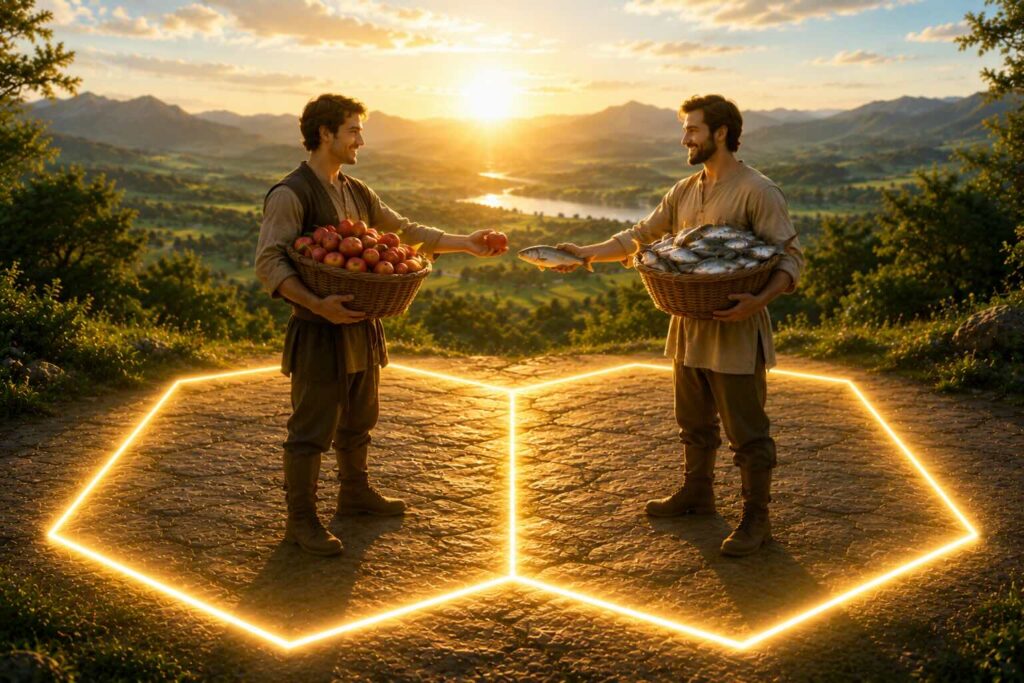
As the incentive to trade leads more people to specialise, a natural division of labour emerges within society. As more people divide their labour, trade becomes a necessity for individuals to meet their numerous needs which aren’t met by their own labour. For example, a table-maker cannot eat his excess tables, nor wear them as clothing. Instead, the incentive is to trade his tables with specialist producers of food and clothing who are unable to make their own tables. In so doing, a market for tables, food, and clothing emerges between them.
Each new market participant brings unique knowledge, skills, and resources, creating new opportunities within the market for mutually beneficial exchange. As the market expands, a carpenter who once traded only with a farmer and a tailor can now also trade with bakers, doctors, blacksmiths, and countless others, allowing otherwise unmet needs to be satisfied. Moreover, the number of potential trading relationships within the market grows non-linearly as new participants enter. For example, a market of 2 people has 1 possible trading relationship; a market of 3 has 3; a market of 4 has 6; a market of 10 has 45, and a market of 100 has 4950. In this way markets exhibit powerful network effects. Every new participant can potentially trade with every existing participant, increasing the opportunities for mutually beneficial exchange, and further incentivising participation in the market itself.
As markets mature, participants continue to specialise and trade, further increasing the division of labour within society. When labour is divided, individuals are incentivised to hone their crafts and seek production efficiencies through innovation, capital investments, and economies of scale. Doing so increases individual productivity and enables each market participant to create more value with the same inputs of labour, time and resources. At the same time, any gaps in the market will be noticed by entrepreneurs as business opportunities, which brings new products and services to the marketplace.
As the level of productivity among market participants increases, more goods and services become available in the marketplace. This increased abundance allows more human needs to be satisfied at a lower opportunity cost, thereby raising the overall standard of living. As the general standard of living rises, unnecessary suffering can be reduced, families can grow, and humanity can flourish. In this manner, free trade within markets drives the process of civilisation.
Free markets are those in which all interactions are voluntary, and the prices of goods and services are determined entirely by demand and supply, rather than by coercion or central direction. Since every exchange requires the consent of all parties, individual sovereignty, self-ownership, and the principle of non-aggression are inherently upheld. Producers cannot force consumers to buy, just as consumers cannot compel producers to sell. Instead, every exchange occurs only when all participants expect to benefit, making free trade peaceful, mutually beneficial, and ethically sound. Therefore, free markets are the most effective and ethical means of allocating scarce resources and promoting human flourishing.

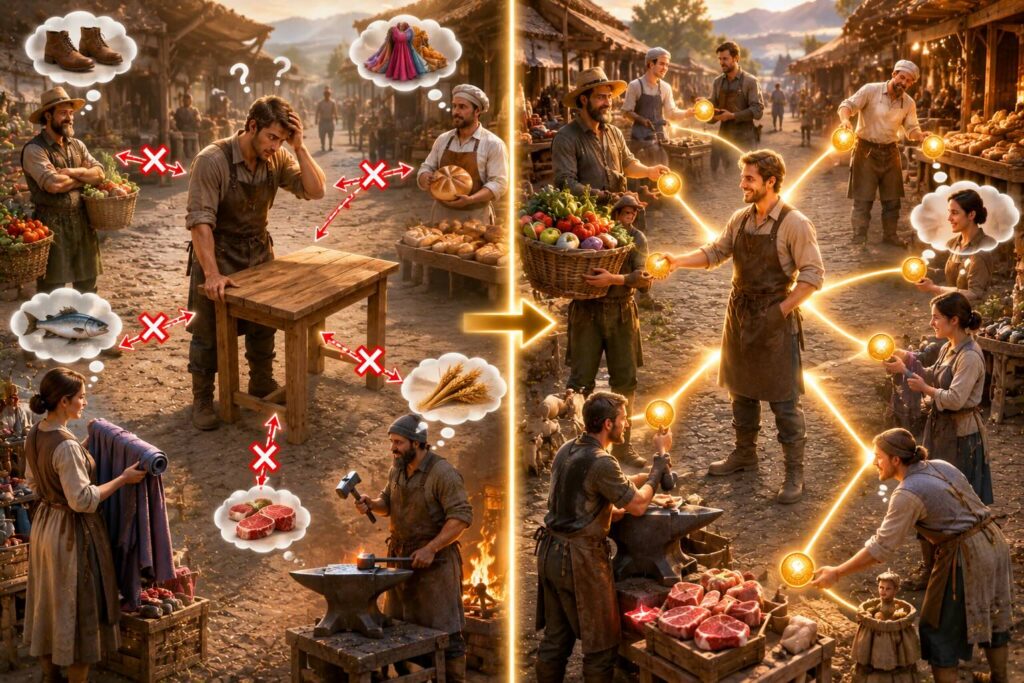
As markets expand, direct barter becomes increasingly inefficient because every trade requires a double coincidence of wants. For example, in order for a table-maker to obtain food he must first find a farmer that simultaneously wants a table. Given this limitation, market participants naturally converge upon certain goods which are best suited to mediating exchange. Such goods tend to best fulfil the 5 monetary properties of divisibility, durability, recognisability, portability and scarcity. Historically, market goods such as salt, grains, shells and precious metals have fulfilled the role of money. In this way, money is not invented by governments, but emerges naturally within free markets. It becomes a universal coordination tool that significantly increases the efficiency of exchange, and therefore enables markets to scale beyond what barter alone could sustain.
When market participants converge upon a monetary good, it begins to serve the 3 monetary functions – store of value, medium of exchange, and unit of account. All else being equal, if the good is sufficiently durable and scarce, it will retain its exchange value over time. This allows its holders to accumulate wealth by deferring consumption and plan ahead for the future. Furthermore, if the good is sufficiently divisible, portable, and recognisable, it will also function well as a medium of exchange. This allows its holders to quickly and precisely transact with anybody in the marketplace, rather than search in vain for a barter partner. And finally, once a monetary good is widely accepted as payment, it becomes the universal unit of account, enabling prices of all other goods and services to be denominated in it. Price then emerges as an indispensable language of value, through which all market actors convey and express their preferences to others.
Because money is the medium through which all humans communicate value and allocate scarce resources, the ethical ‘soundness’ of money becomes extremely important. A monetary system can either respect or undermine the ethical principles upon which free markets and civilisation depend, including individual sovereignty, property rights, and voluntary cooperation. Since money itself emerges through market selection, the most ethically sound money is one that’s chosen voluntarily by all for its inherent monetary properties, rather than one imposed through coercion or central design. Any currency that is coercively imposed upon society necessarily violates the individual’s right to liberty, and likely benefits its issuers at the expense of everyone else. Such a ‘money’ is therefore not ethically sound and likely causes unnecessary suffering.
Conclusion
Reality exists, and within it exist conscious individuals who seek truth and exercise agency in a world constrained by scarcity. Because scarcity exists, suffering becomes an unavoidable part of life. Since conscious beings universally seek to reduce their own unnecessary suffering, ‘good’ and ‘bad’ can be understood as objective descriptions of the states we consistently pursue and avoid. Ethics therefore becomes the study of how individuals ought to act, if they wish to promote flourishing and minimise unnecessary suffering.
From these foundations emerge the ethical principles of responsibility, individual sovereignty, self-ownership, natural human rights, non-aggression, and voluntary cooperation. When individuals interact according to these principles, they naturally seek mutually beneficial outcomes through trade. As trade expands, markets emerge, enabling greater specialisation, productivity, and abundance than any individual could achieve alone. As markets mature, money itself emerges as the market good best suited to perform the three functions of money (store of value, medium of exchange, and unit of account), by virtue of its monetary properties (divisibility, durability, recognisability, portability, and scarcity).
Just as ethics, trade, and markets emerge as solutions to real human problems, so too does money. When money naturally emerges, it embodies the same ethical principles of truth, responsibility, property rights, voluntary cooperation, and individual sovereignty that gave rise to it. This makes ethically sound money a powerful tool for human flourishing and the advancement of civilisation. Conversely, a money that is imposed through dictate, mandate, or legal privilege, embodies a different set of values, and will likely produce different incentives and outcomes. Having established what ‘good’ and ‘bad’ mean, we are now equipped to judge money by that standard. The pivotal question remains: does the money we use today embody the ethical principles which promote human flourishing, or not? If not, what kind of money best aligns with those principles?

Bitcoin First Principles
Continue your learning by clicking the next section below (Philosophy & Ethics).
Leave a Reply